Hermes Agent vs OpenClaw: 2026년 현재 더 앞선 AI 에이전트는?
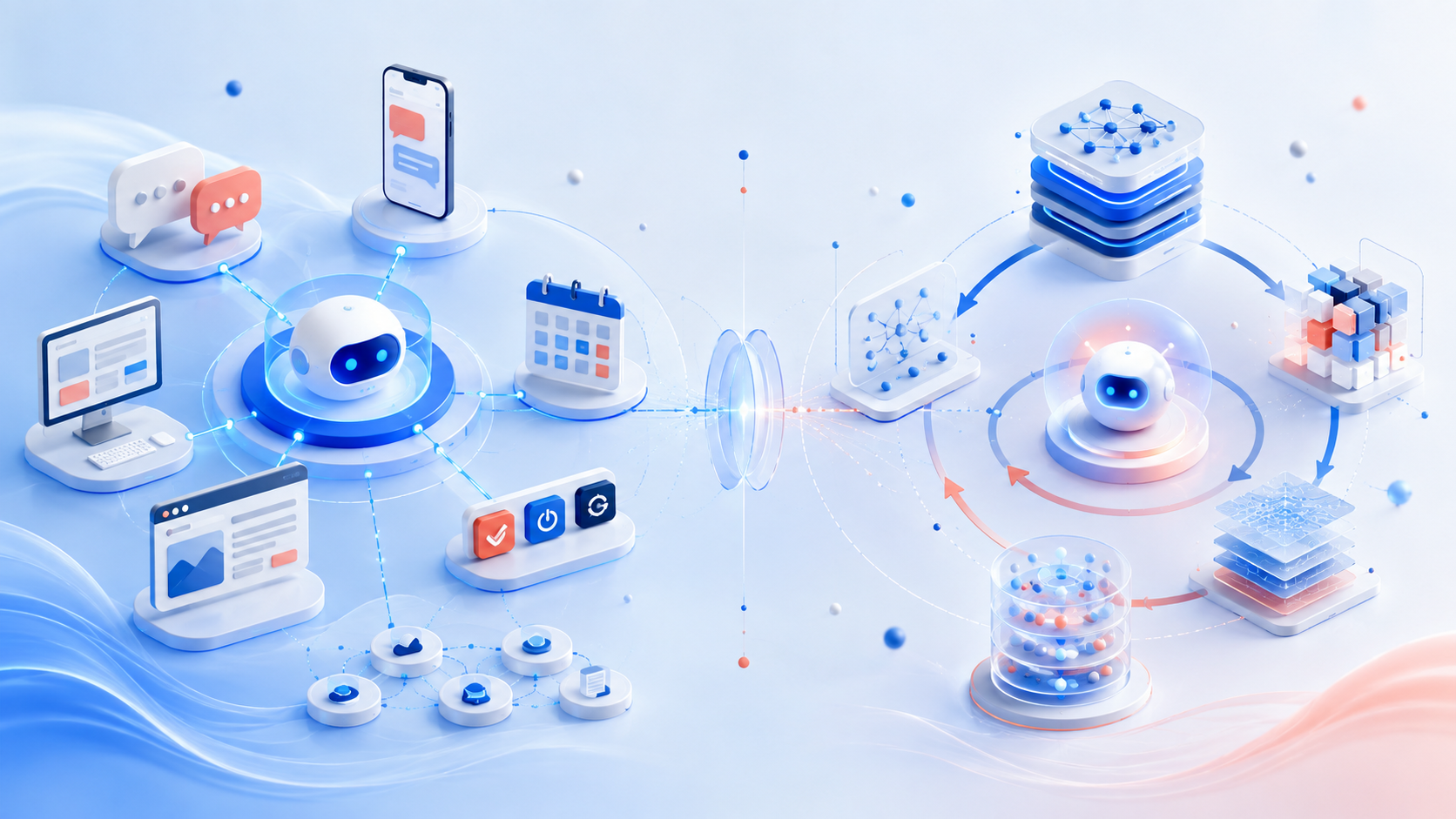
대화만 나누는 AI를 넘어, 파일을 읽고 터미널과 브라우저를 조작하며 예약 작업까지 수행하는 개인용 AI 에이전트 런타임이 빠르게 성장하고 있습니다. 오픈소스 진영에서는 Hermes Agent와 OpenClaw가 대표적인 비교 대상입니다.
이 글은 2026년 9월 4일 공개된 공식 사이트·문서·저장소를 기준으로 두 제품을 비교합니다. 두 프로젝트 모두 업데이트 속도가 매우 빠르므로, 설치 전에는 연결된 공식 문서에서 현재 기능과 보안 기본값을 다시 확인하세요.
먼저 결론: 전체 운영은 OpenClaw, 에이전트 실험은 Hermes
짧게 말하면 24시간 개인 비서와 여러 기기·메신저를 잇는 운영 시스템이 필요할 때는 OpenClaw가 근소하게 앞섭니다. 반대로 브라우저 백엔드, 메모리 공급자, 모델 조합과 에이전트 동작 자체를 깊게 실험하려면 Hermes Agent가 특히 매력적입니다.
다만 “Hermes는 자기학습, OpenClaw는 운영”이라는 예전 구분은 더 이상 충분하지 않습니다. 현재 OpenClaw에는 Skill Workshop과 기본 auto 자기학습이 있고, Hermes에는 Kanban, Session Heartbeat, Persistent Goals가 있습니다. 이제 차이는 기능의 유무보다 어느 계층을 더 제품답게 다듬었는가에 가깝습니다.
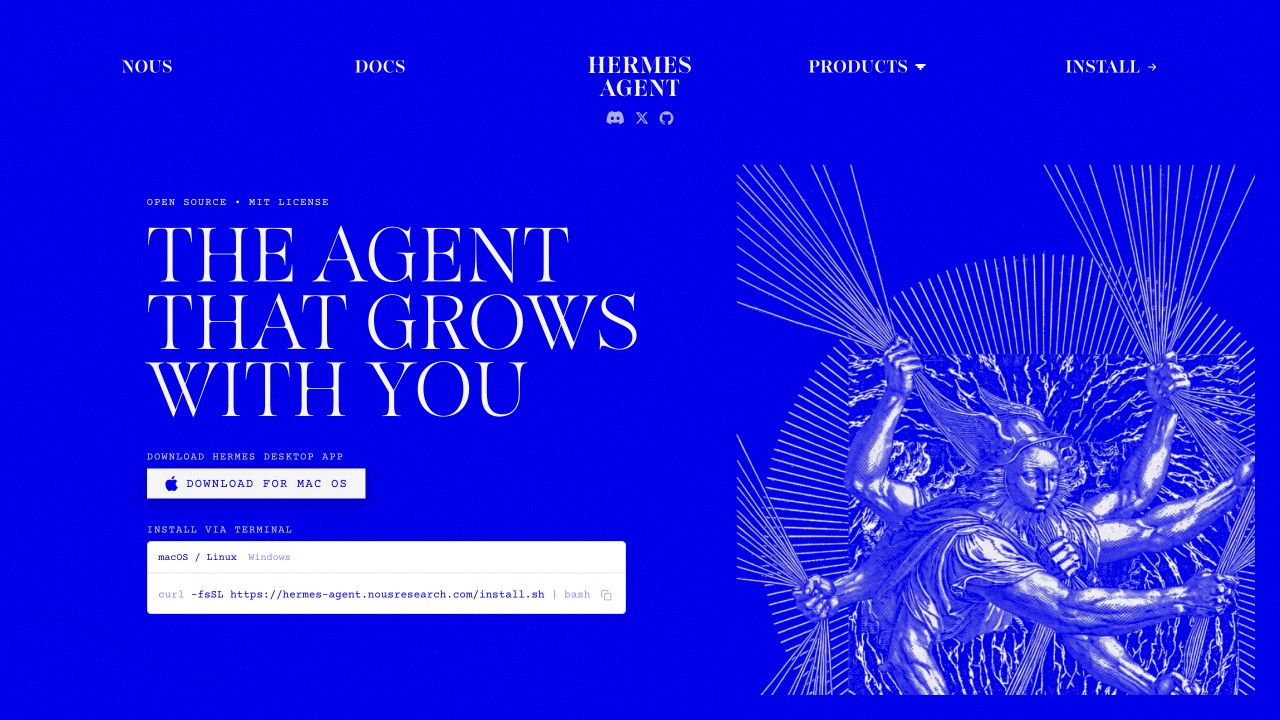
출처: Hermes Agent 공식 사이트, 2026-09-04 캡처.
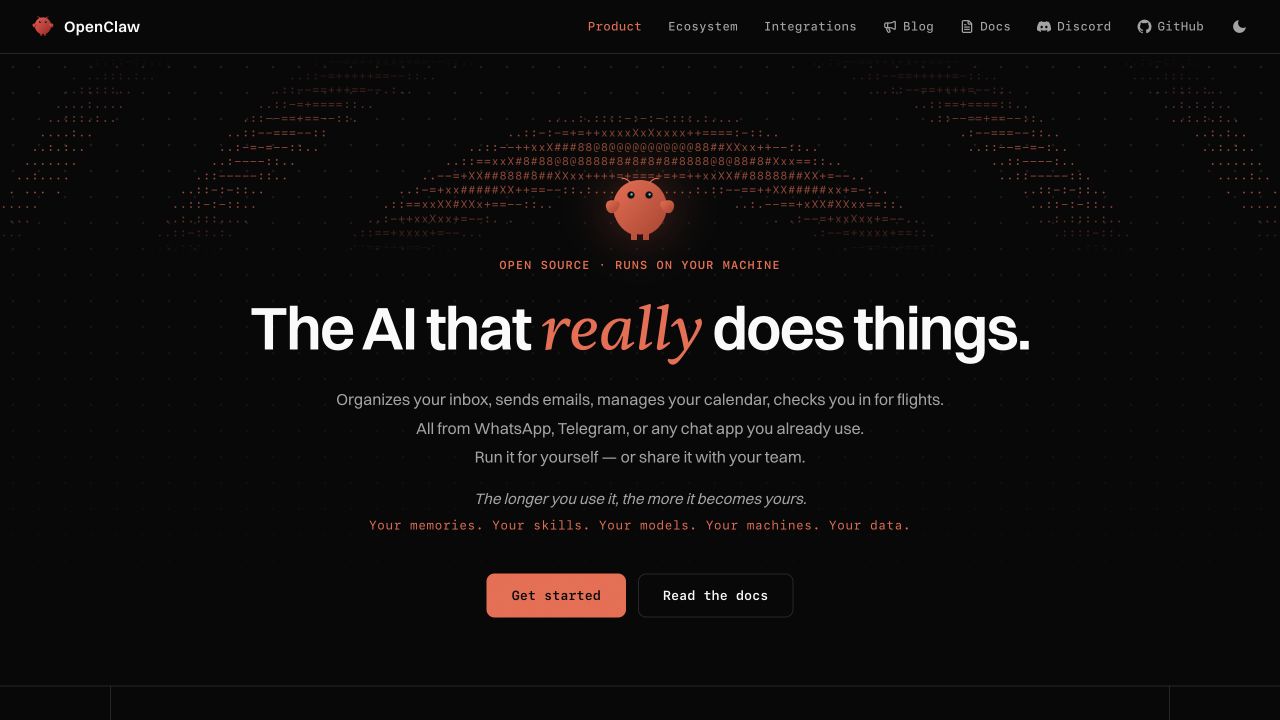
출처: OpenClaw 공식 사이트, 2026-09-04 캡처.
Hermes Agent와 OpenClaw는 무엇인가?
Hermes Agent: 성장하는 범용 에이전트 런타임
Hermes Agent는 Nous Research가 개발하는 MIT 라이선스의 모델 독립형 에이전트입니다. CLI, TUI, 데스크톱 앱, 메시징 게이트웨이에서 같은 핵심 런타임을 사용하고, 터미널·파일·웹·브라우저·미디어 도구를 조합합니다.
제품의 중심 언어는 “The Agent That Grows With You”입니다. MEMORY.md와 USER.md에 장기 지식을 남기고, 반복 가능한 절차를 Skills로 만들며, 필요하면 외부 메모리 공급자나 브라우저 백엔드를 바꿀 수 있습니다. 연구용 프레임워크처럼 유연하지만, 최근에는 Dashboard와 Kanban까지 갖춘 운영 도구로도 빠르게 확장했습니다.
OpenClaw: Gateway를 중심으로 한 개인 AI 플랫폼
OpenClaw는 사용자의 장치에서 실행되는 MIT 라이선스의 개인 AI 어시스턴트입니다. 하나의 장기 실행 Gateway가 WhatsApp, Telegram, Discord, Slack, Signal, iMessage, WebChat과 앱·CLI·웹 UI·자동화를 연결합니다.
핵심은 단일 채팅 앱이 아니라 항상 켜져 있는 제어 평면입니다. 대화 채널, 에이전트 세션, 브라우저, 장치 노드, 예약 작업과 백그라운드 태스크가 Gateway에 모입니다. 공식 사이트는 29개 채널과 macOS·Windows·Linux 데스크톱 앱, iOS·Android 노드를 안내합니다.
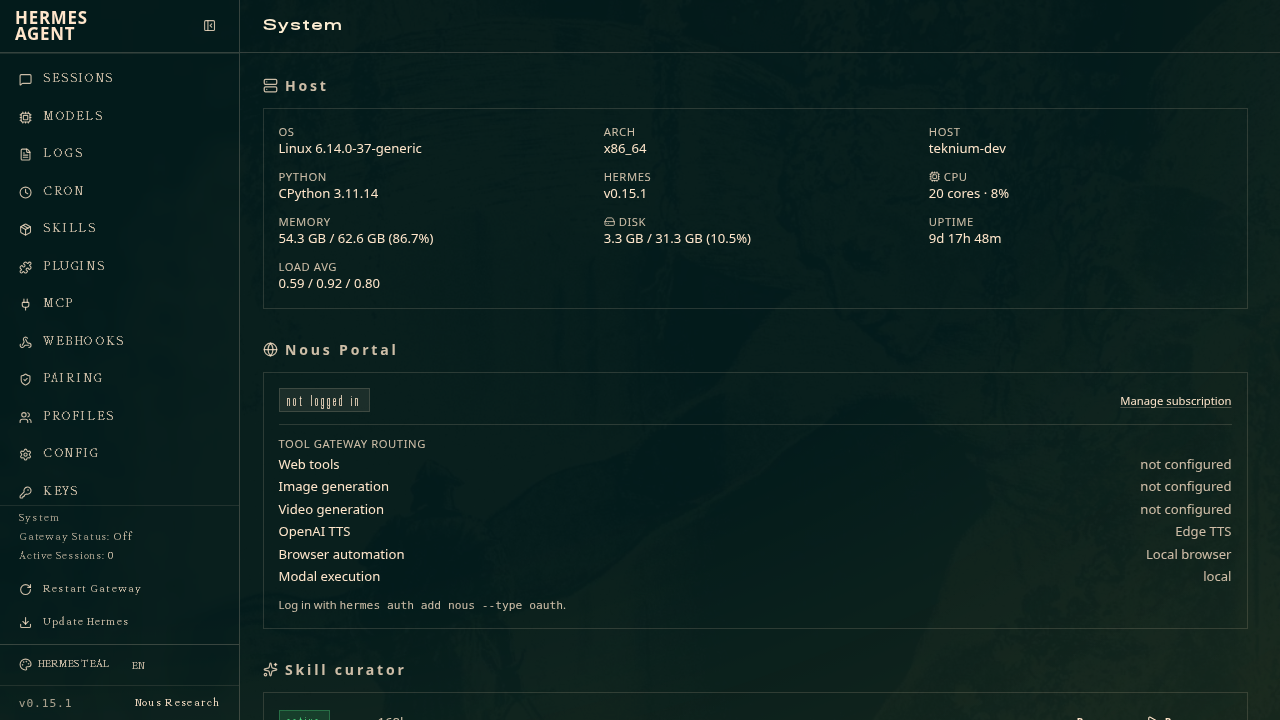
출처: Hermes Agent 공식 저장소의 Dashboard 화면.

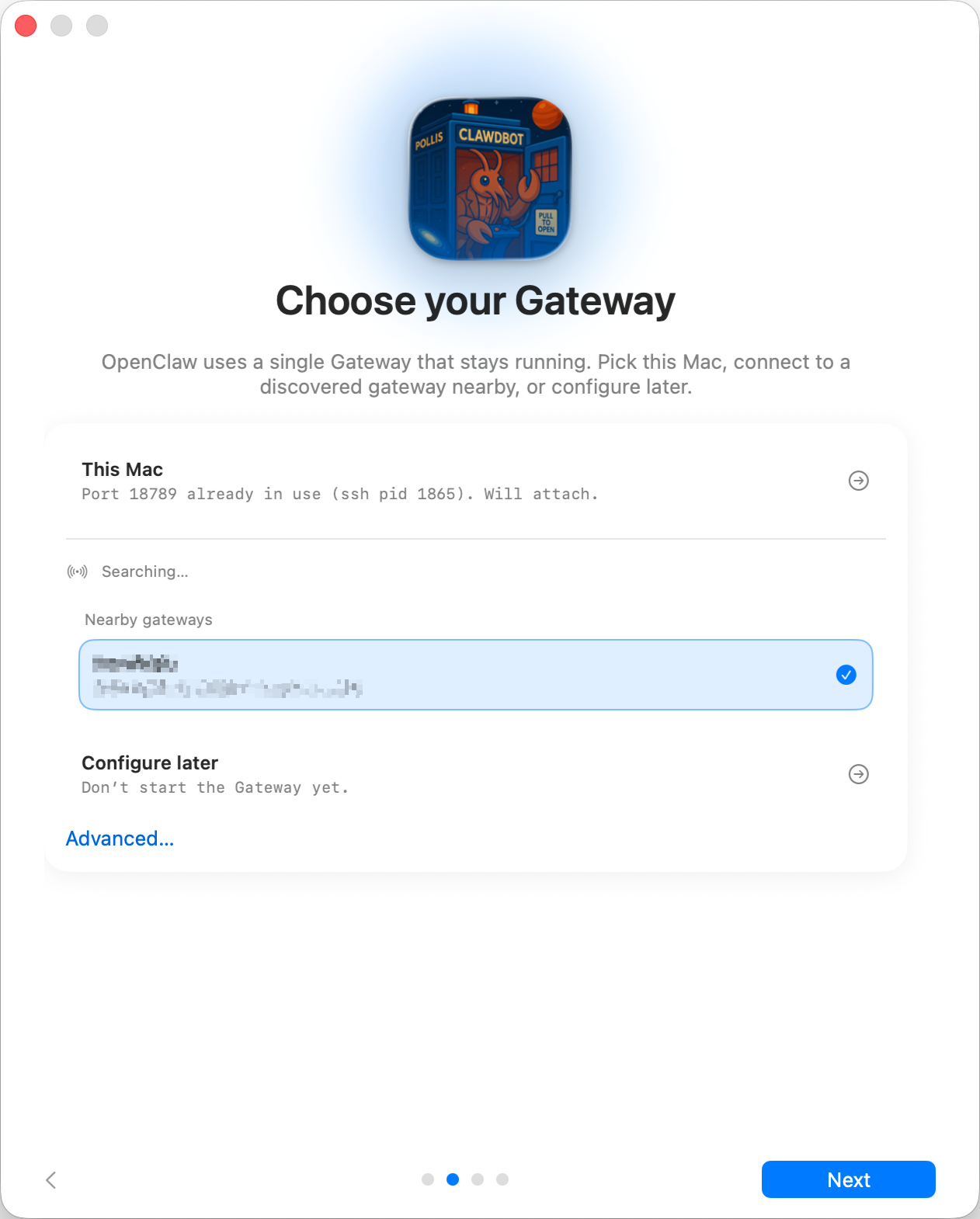
출처: OpenClaw 공식 저장소의 macOS 온보딩 자료.

핵심 비교표
| 비교 기준 | Hermes Agent | OpenClaw | 현재 판단 |
|---|---|---|---|
| 기본 철학 | 성장·실험 가능한 범용 에이전트 런타임 | 항상 켜진 개인 AI 플랫폼 | 목적에 따라 다름 |
| 핵심 구조 | CLI·Desktop·Gateway가 같은 에이전트 코어 공유 | 장기 실행 Gateway가 채널·앱·노드·자동화 통합 | OpenClaw 운영 구조 우세 |
| 라이선스 | MIT | MIT | 동일 |
| 모델 선택 | 호스팅·로컬·OpenAI 호환 공급자 등 모델 독립 | 호스팅·구독·Gateway·로컬 모델 지원 | 둘 다 강함 |
| 브라우저 기본 선택지 | Browser Use, Browserbase, Firecrawl, Camofox, Lightpanda, 로컬 CDP 등 | 관리형 브라우저, 실제 Chrome, 원격 CDP, Browserbase·Browserless·Notte 등 | Hermes가 종류에서 근소 우세 |
| 로그인된 브라우저 | 실제 프로필 스냅샷 또는 로컬 CDP | Chrome DevTools MCP로 기존 세션 연결 | 둘 다 가능, 방식이 다름 |
| Skills | SKILL.md, Skills Hub, 생성·개선 도구 | AgentSkills 호환, ClawHub, Skill Workshop | 둘 다 강함 |
| 자기학습 | 제품 정체성에 가까운 스킬 생성·개선 | 기본 auto, 제안·스캔·해시·롤백을 거치는 관리형 학습 | Hermes는 실험성, OpenClaw는 거버넌스 |
| 장기 메모리 | 파일 메모리 + 8개 외부 공급자 중 선택 | 파일 메모리 + 검색 엔진·Dreaming·Memory Wiki | 실험은 Hermes, 내장 수명주기는 OpenClaw |
| 메시징·기기 | 20개 이상 플랫폼, Gateway | 29개 채널, 데스크톱·모바일 노드 | OpenClaw 우세 |
| 예약·상시 작업 | Cron, Session Heartbeat, Persistent Goals | Automations, Heartbeat, Tasks, Hooks, Standing Orders | OpenClaw가 구조적으로 더 세분화 |
| 멀티 에이전트 | Subagent Delegation + 영속 Kanban 보드 | Sub-agents + Background Tasks + Task Flow | 둘 다 강함 |
| 특히 잘 맞는 경우 | 브라우저·메모리·모델·에이전트 연구와 커스텀 런타임 | 개인 비서, 원격 채널, 여러 기기, 장기 운영 | 선택 기준 |
1. 브라우저 자동화: Hermes의 폭, OpenClaw의 운영 일관성
두 제품 모두 접근성 트리나 AI용 스냅샷에서 안정적인 요소 참조를 만들고, 클릭·입력·스크롤·스크린샷을 실행합니다. 따라서 “브라우저 자동화가 있느냐”가 아니라 어떤 브라우저를 어떤 신뢰 경계에서 사용할 것인가가 핵심입니다.
Hermes는 Browser Use Cloud, Browserbase, Firecrawl, Camofox, Lightpanda, 로컬 Chromium 계열 CDP, agent-browser를 공식 선택지로 제공합니다. 공개 웹은 클라우드 브라우저로, localhost와 사내망은 로컬 sidecar로 자동 라우팅하는 하이브리드 방식도 문서화돼 있습니다. 백엔드와 엔진을 바꾸며 실험해야 하는 개발자에게 유리합니다.
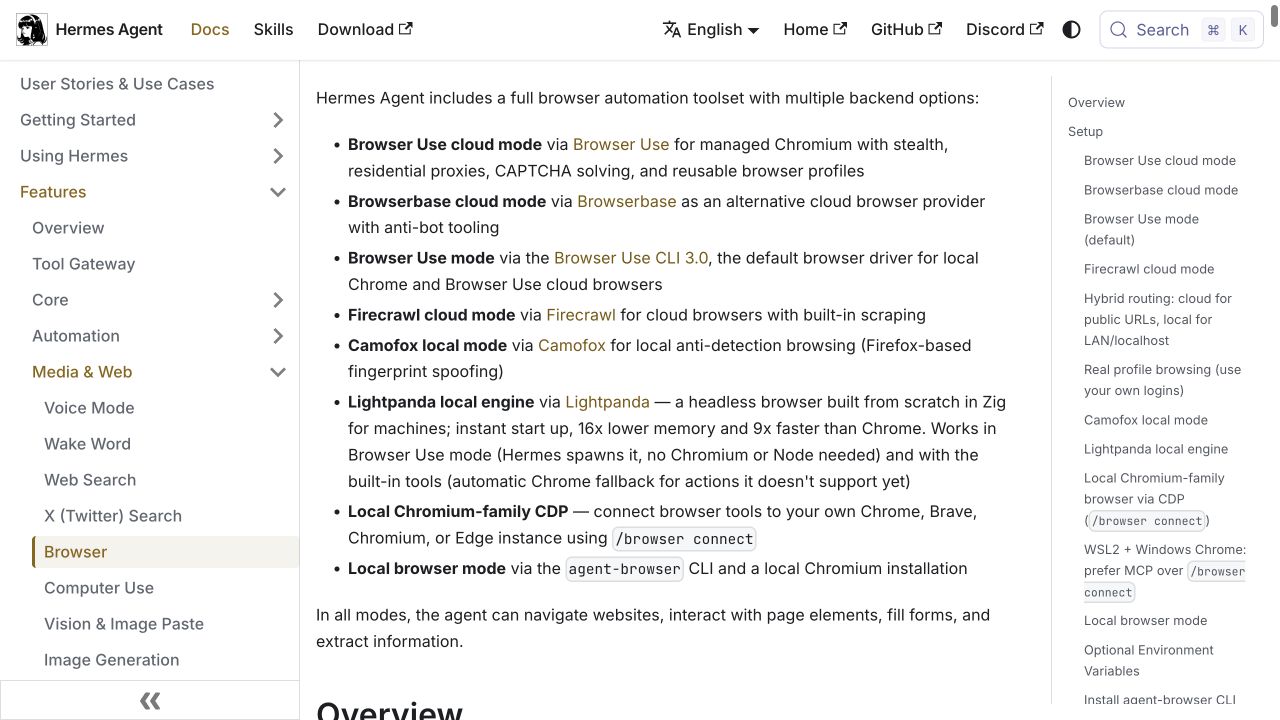
출처: Hermes Agent 브라우저 자동화 문서, 2026-09-04 캡처.
OpenClaw의 기본 openclaw 프로필은 개인 브라우저와 분리된 에이전트 전용 Chromium 계열 브라우저입니다. 로그인 상태가 필요하면 user 프로필이 Chrome DevTools MCP로 실행 중인 Chromium 계열 세션에 붙습니다. 원격 CDP와 Browserless, Browserbase, Notte도 프로필로 구성할 수 있어 선택지가 적다고 단정하기는 어렵습니다.
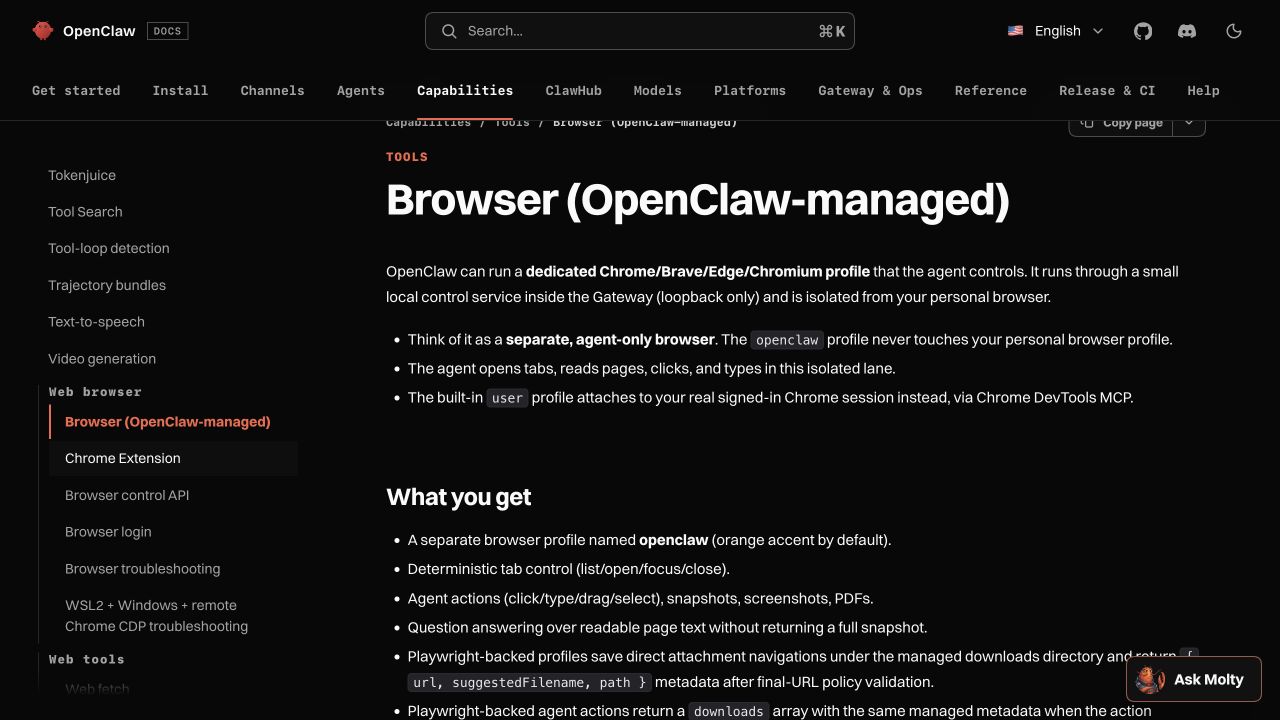
출처: OpenClaw Browser 문서, 2026-09-04 캡처.
실무에서는 로그인 편의보다 안전을 먼저 보세요. 에이전트 전용 프로필은 개인 쿠키와 계정을 분리해 사고 반경을 줄입니다. 실제 브라우저 연결은 결제·메일·관리자 콘솔처럼 권한이 큰 세션에 접근할 수 있으므로, 사용자가 앞에 있을 때 승인하고 작업 후 연결을 끊는 편이 안전합니다.
2. Skills와 자기학습: 이제 둘 다 스스로 배운다
Hermes와 OpenClaw 모두 폴더 안의 SKILL.md를 중심으로 재사용 가능한 절차를 정의합니다. 차이는 Skills를 얻고 고치는 흐름입니다.
Hermes는 Skills Hub에서 공식·커뮤니티 Skills를 검색하고, 에이전트가 skill_manage로 새 스킬을 만들거나 기존 스킬을 개선할 수 있습니다. “성공한 해결법을 다음 세션의 도구로 바꾼다”는 철학이 제품 전반에 직접 드러납니다.
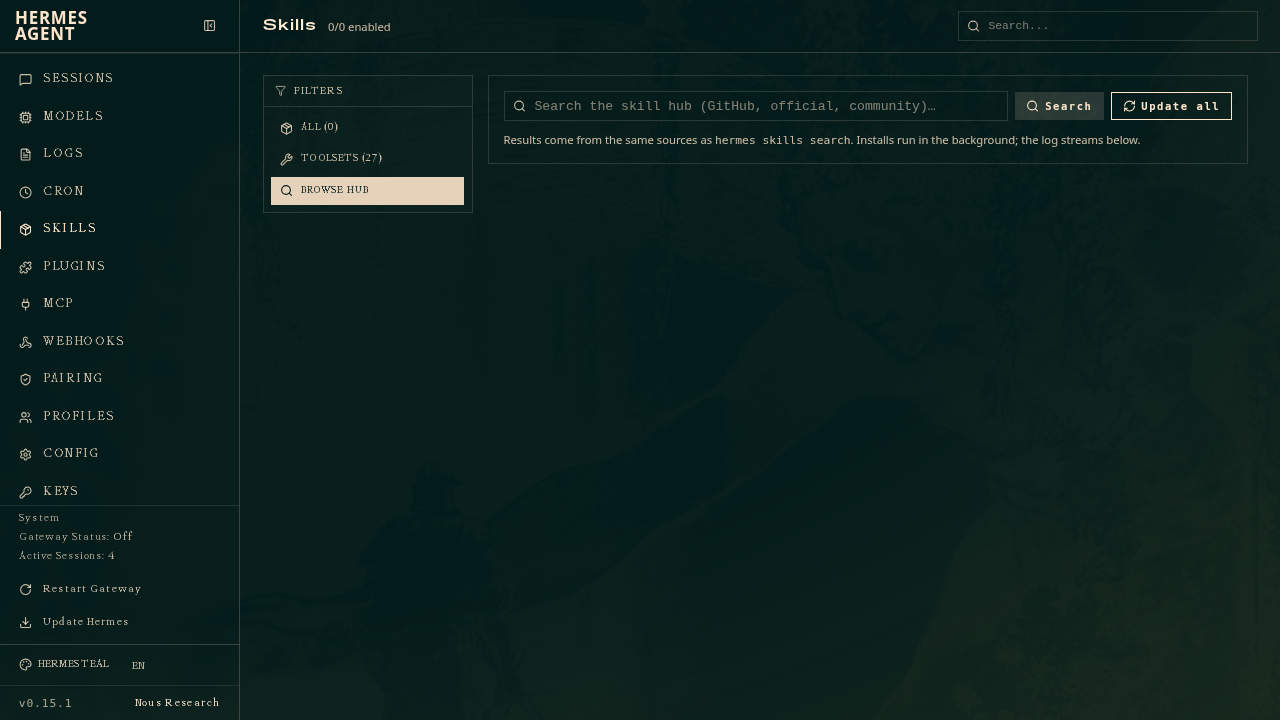
출처: Hermes Agent 공식 저장소의 Skills Hub 화면.

OpenClaw도 이제 단순히 ClawHub에서 Skills를 설치하는 수준이 아닙니다. Self-learning은 교정과 성공 경험을 재사용 가능한 Skill로 바꾸며 기본 모드는 auto입니다. 다만 적용 전 보안 스캔, 대상 해시 결합, 롤백 메타데이터, 사용자 작성 Skill 보호를 거치는 Skill Workshop이 변화의 관문 역할을 합니다.
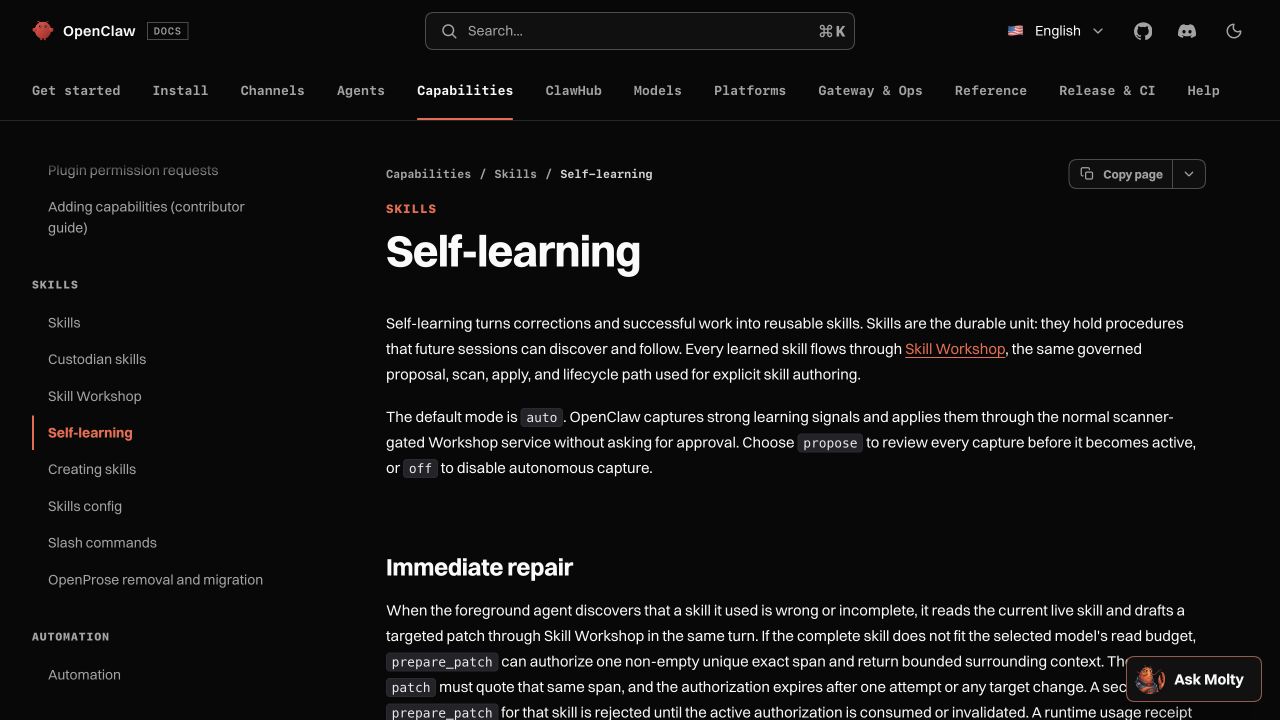
출처: OpenClaw Self-learning 문서, 2026-09-04 캡처.
따라서 “자기개선은 Hermes만의 기능”이라는 평가는 현재 기준으로 틀렸습니다. Hermes는 에이전트 실험성과 직접성이 돋보이고, OpenClaw는 자동 학습을 검토·격리·복구할 수 있는 운영 기능으로 만든 점이 강합니다.
3. Memory: 공급자 다양성과 내장 수명주기의 대결
Hermes의 기본 파일 메모리는 USER.md와 MEMORY.md입니다. 여기에 Honcho, Mem0, Hindsight, Holographic, RetainDB, ByteRover, Supermemory, OpenViking 등 8개 외부 공급자 플러그인 중 하나를 활성화할 수 있습니다. 메모리 연구나 공급자별 성능 비교에는 매우 유리합니다.
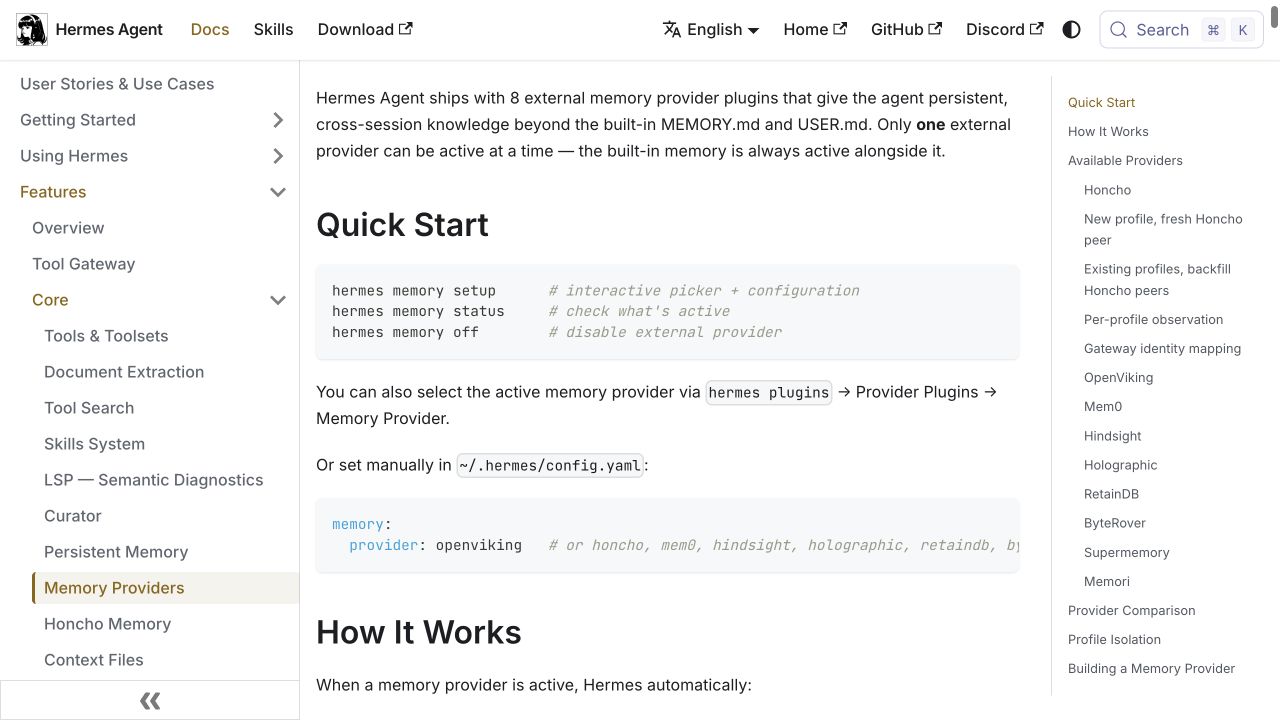
출처: Hermes Agent Memory Providers 문서, 2026-09-04 캡처.
OpenClaw는 USER.md, MEMORY.md, 날짜별 memory/YYYY-MM-DD.md, 선택적 DREAMS.md를 서로 다른 층으로 사용합니다. 기본 SQLite 엔진에 하이브리드 검색을 붙이고, Honcho·LanceDB 플러그인과 Memory Wiki를 선택할 수 있습니다. Dreaming은 단기 신호를 평가해 검증된 내용을 장기 메모리로 승격하고, 결과를 사람이 검토할 수 있게 남깁니다.
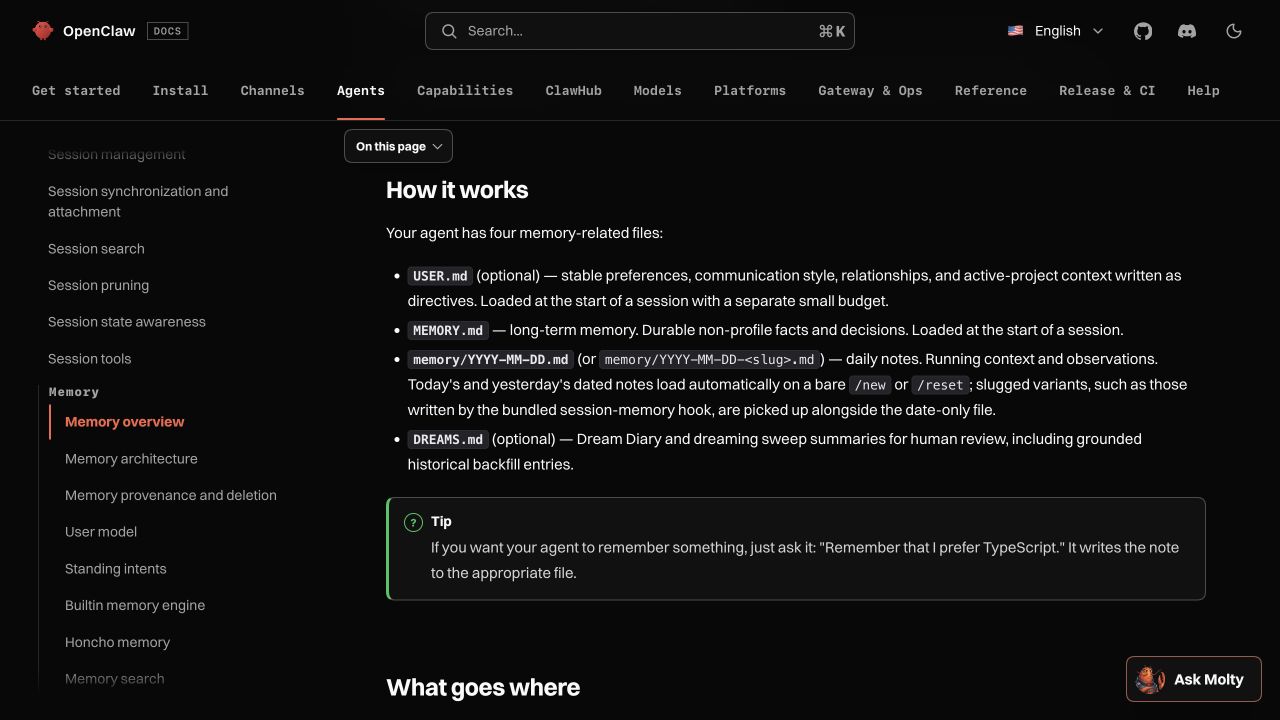
출처: OpenClaw Memory 문서, 2026-09-04 캡처.
선택 기준은 분명합니다. 여러 외부 메모리 시스템을 바꿔 끼우며 실험하려면 Hermes가 편하고, 기록·검색·승격·검토·삭제까지 하나의 내장 수명주기로 운영하려면 OpenClaw가 더 촘촘합니다.
4. 자동화와 멀티 에이전트: 격차가 가장 빠르게 줄어든 영역
Hermes의 Cron은 일회성·반복 작업, 일시정지·재개·편집, Skill 첨부, 채널 전달, 모델 없는 스크립트 실행까지 지원합니다. /heartbeat는 현재 대화의 문맥을 유지한 채 유휴 시간에 반복 지시를 실행하고, /goal은 완료될 때까지 같은 목표를 이어갑니다.
짧은 병렬 작업은 delegate_task로 분리된 서브에이전트에 맡깁니다. 재시작을 견뎌야 하는 장기 협업은 SQLite 기반 Kanban 보드에서 작업·담당 프로필·리뷰·재시도·감사 기록을 관리합니다. 즉 Hermes도 더 이상 단순한 “부모가 기다리는 서브에이전트”에 머물지 않습니다.
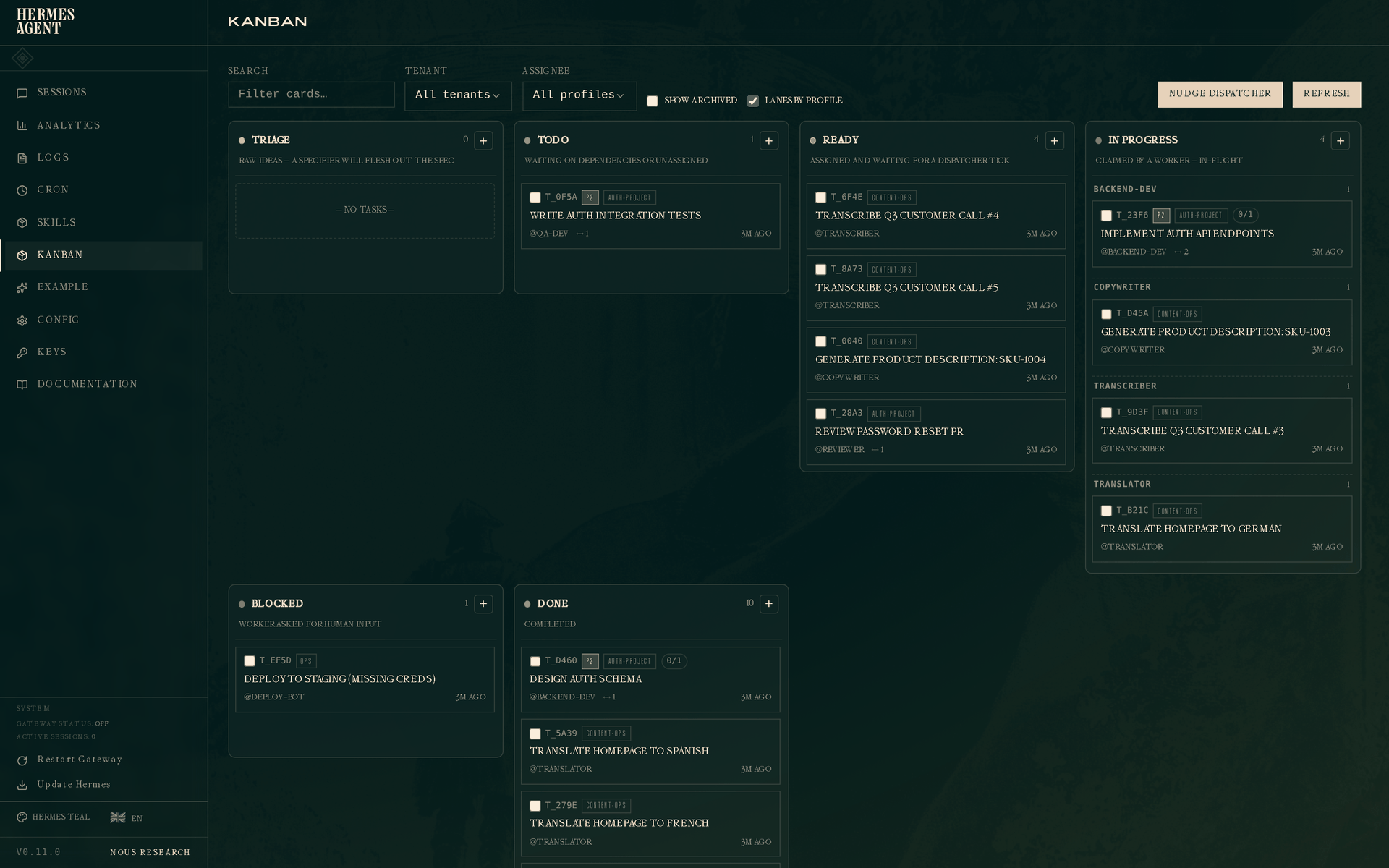
출처: Hermes Agent Kanban 튜토리얼 자료.

OpenClaw는 자동화를 더 세분화합니다. Automations는 예약을, Heartbeat는 주기적 메인 세션 점검을, Background Tasks는 분리 실행의 원장을, Task Flow는 다단계 오케스트레이션을 맡습니다. Hooks는 이벤트에 반응하고 Standing Orders는 모든 세션에 지속 지침을 주입합니다.
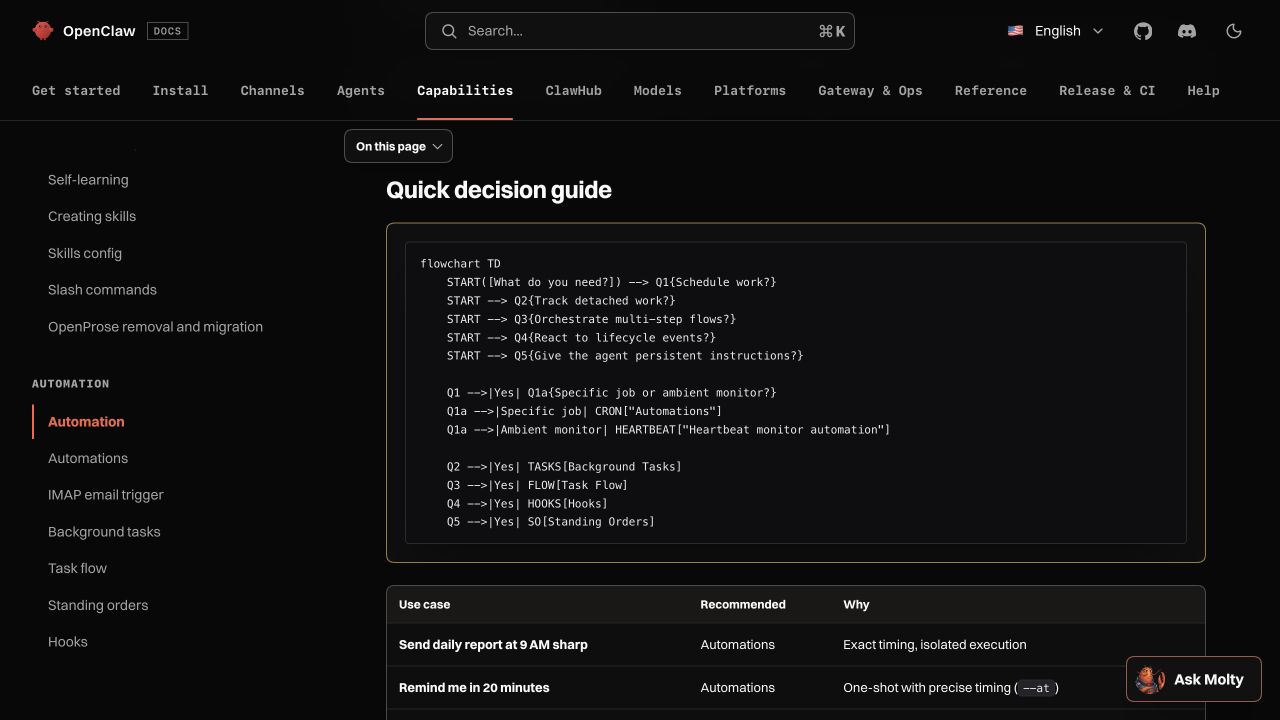
출처: OpenClaw Automation 문서, 2026-09-04 캡처.
두 제품 모두 병렬 에이전트와 상시 실행이 가능하지만, OpenClaw는 각 실행을 Gateway의 운영 모델 안에서 추적하고 채널로 전달하는 계층이 더 일관됩니다. Hermes의 Kanban은 개발·연구 파이프라인처럼 역할이 분명한 작업에서 강력하고, OpenClaw의 Tasks와 Task Flow는 개인 비서의 여러 백그라운드 활동을 한곳에서 감사하기 좋습니다.
5. 메시징과 인터페이스: OpenClaw의 가장 분명한 우세
Hermes도 Telegram, Discord, Slack, WhatsApp, Signal, 이메일, CLI 등 20개 이상의 플랫폼을 지원합니다. 그러나 OpenClaw는 29개 채널과 macOS·Windows·Linux 앱, iOS·Android 노드, 웹 Control UI를 Gateway의 단일 연결 모델로 묶습니다.
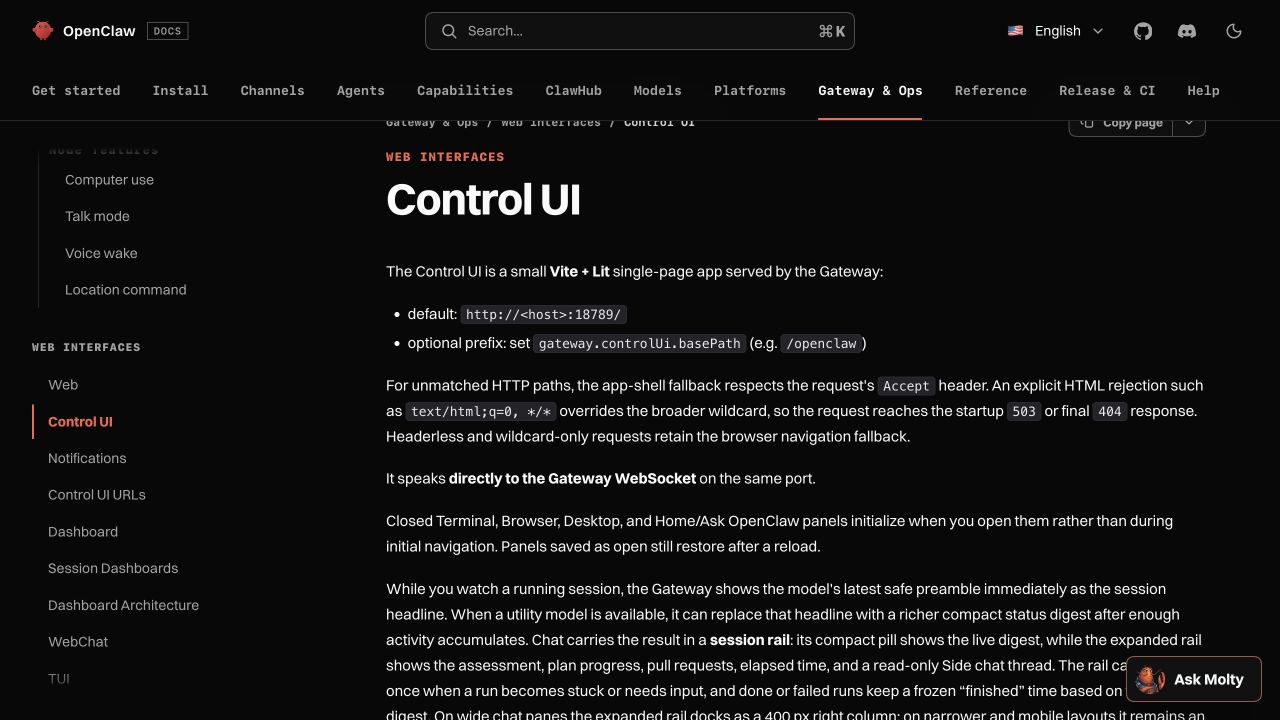
출처: OpenClaw Control UI 문서, 2026-09-04 캡처.
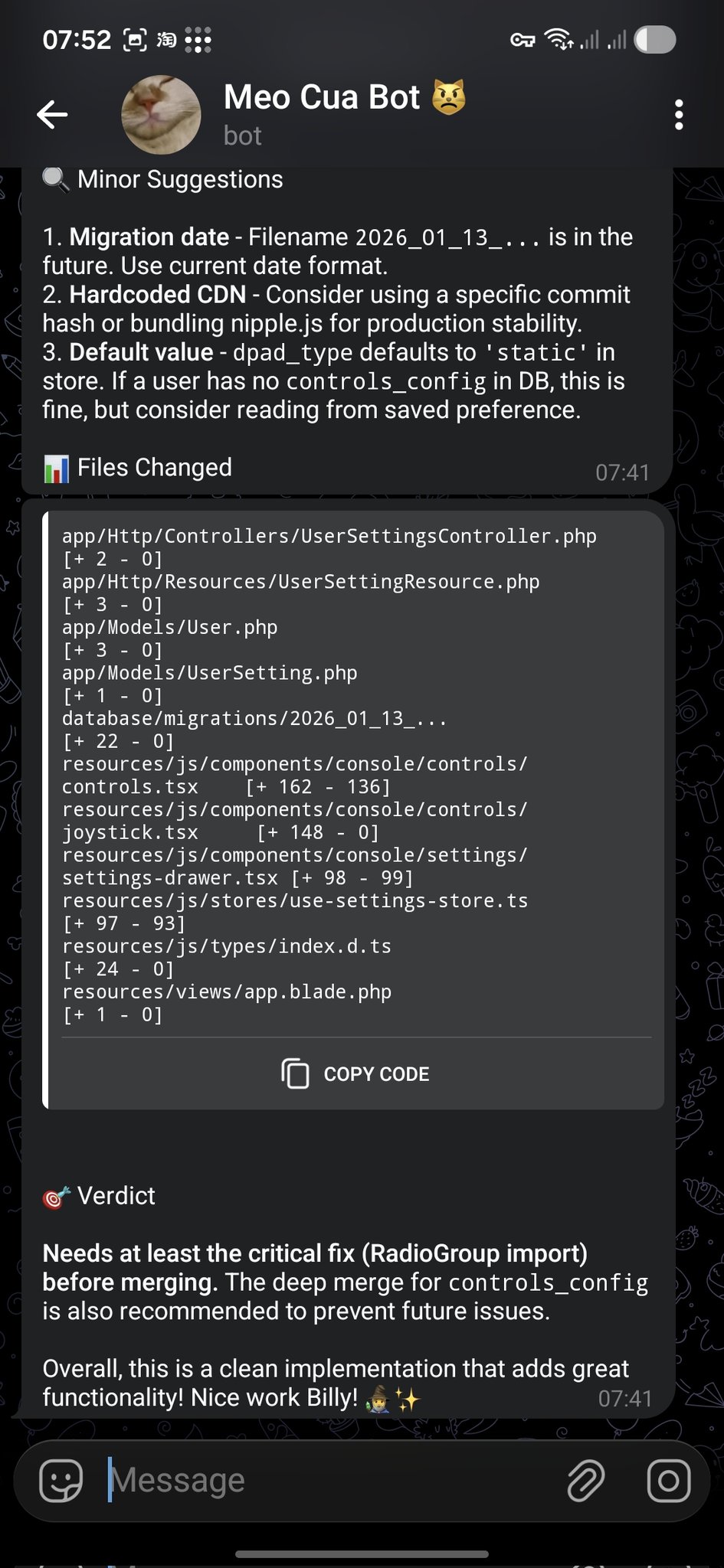

휴대전화 메신저에서 요청하고 집이나 사무실의 Mac mini가 처리한 뒤 결과를 다시 채널로 받는 사용 방식에서는 OpenClaw가 더 완성된 제품 경험을 제공합니다. Hermes도 같은 패턴을 구현할 수 있지만, 다양한 장치와 채널을 하나의 개인 운영체제처럼 관리하는 감각은 OpenClaw의 핵심 강점입니다.
어떤 사람에게 무엇이 맞을까?
| 목적 | 추천 | 이유 |
|---|---|---|
| 24시간 개인 AI 비서 | OpenClaw | Gateway, 채널, 앱, 노드, 전달 정책이 한 운영 모델로 연결됨 |
| Mac mini·서버 상시 운영 | OpenClaw | 장기 실행 Gateway와 Control UI, 태스크 원장이 성숙함 |
| Telegram·WhatsApp 중심 원격 작업 | OpenClaw | 채널 생태계와 백그라운드 결과 전달이 강함 |
| 복잡한 예약·감사 가능한 워크플로 | OpenClaw | Automations, Tasks, Task Flow, Hooks가 역할별로 분리됨 |
| 다양한 브라우저 백엔드 실험 | Hermes Agent | 클라우드·로컬·경량·안티디텍션 엔진 선택 폭이 넓음 |
| 외부 Memory 공급자 비교 | Hermes Agent | 8개 공급자를 플러그인으로 교체 가능 |
| 자기개선 에이전트 연구 | Hermes Agent | 성장과 스킬화를 런타임의 핵심 철학으로 둠 |
| 장기 멀티 에이전트 개발 파이프라인 | Hermes Agent | 영속 Kanban과 프로필 기반 작업자 모델이 명확함 |
| 통제 가능한 자동 Skill 학습 | OpenClaw | Workshop의 스캔·해시·격리·롤백 절차가 구체적임 |
설치 전에 꼭 확인할 보안 원칙
두 제품 모두 터미널, 파일, 로그인된 브라우저와 메시징 계정에 접근할 수 있습니다. 기능이 많을수록 기본 신뢰 범위를 작게 시작해야 합니다.
- 개인 브라우저 대신 분리된 에이전트 프로필부터 사용합니다.
- 메일 발송, 결제, 삭제, 배포는 사람의 승인을 남깁니다.
- Gateway와 Dashboard를 공용 인터넷에 직접 노출하지 않습니다.
- Tailscale·VPN·SSH 터널과 강한 인증을 사용합니다.
- Skills와 플러그인을 설치하기 전에 파일과 권한을 검토합니다.
- 자기학습은 처음에 제안·검토 모드로 운영하고 변경 이력을 확인합니다.
- 중요한 파일은 백업하고, 별도 계정이나 샌드박스에서 먼저 시험합니다.
최종 판단
2026년 9월 현재 전체 시스템의 완성도에서는 OpenClaw가 근소 우세라고 판단합니다. 이유는 모델 성능이 아니라 Gateway를 중심으로 채널, 장치, 브라우저, 태스크, 자동화와 UI를 일관되게 운영하는 제품 구조입니다.
하지만 Hermes Agent가 뒤처진 제품이라는 뜻은 아닙니다. 브라우저 공급자 폭, 외부 메모리 실험, Skills 중심 성장 철학, 영속 Kanban과 목표 루프는 오히려 에이전트 연구자와 고급 사용자에게 더 흥미로운 선택일 수 있습니다.
결국 질문은 “무엇이 더 많은 기능을 가졌는가”가 아니라 다음 두 가지로 바뀝니다.
- 내 삶의 여러 채널과 장치를 오래 운영할 AI가 필요한가? → OpenClaw
- 내가 조립하고 실험하며 성장 방식을 바꿀 에이전트 런타임이 필요한가? → Hermes Agent
둘 다 빠르게 진화하고 있으므로, 최종 선택 전에는 동일한 저위험 작업을 각각 실행해 성공률, 승인 횟수, 로그 가독성, 복구 가능성과 실제 비용을 비교하는 것이 가장 정확합니다.
공식 자료
Personal AI agent runtimes now read files, operate terminals and browsers, and run scheduled work. Hermes Agent and OpenClaw are two leading open-source examples.
This comparison is based on official websites, documentation, and repositories available on September 4, 2026. Both projects change quickly, so verify current features and security defaults in the linked documentation before installing either one.
The short answer: OpenClaw for operations, Hermes for agent experimentation
OpenClaw is slightly ahead when the goal is an always-on personal assistant connecting multiple devices and messaging channels. Hermes Agent is especially attractive when you want to experiment deeply with browser backends, memory providers, models, and the behavior of the agent runtime itself.
The old summary—“Hermes learns while OpenClaw operates”—is no longer sufficient. OpenClaw now has Skill Workshop and self-learning in auto mode by default. Hermes now has Kanban, Session Heartbeats, and Persistent Goals. The difference is less about whether a feature exists and more about which layer each project has turned into the stronger product.
Source: official Hermes Agent website, captured 2026-09-04.
Source: official OpenClaw website, captured 2026-09-04.
What are Hermes Agent and OpenClaw?
Hermes Agent: a general-purpose runtime designed to grow
Hermes Agent is a model-agnostic agent from Nous Research under the MIT License. Its CLI, TUI, desktop app, and messaging gateway share the same core runtime, combining terminal, file, web, browser, and media tools.
Its product language centers on “The Agent That Grows With You.” Long-term knowledge lives in MEMORY.md and USER.md; repeatable procedures become Skills; and operators can swap memory providers or browser backends. It remains flexible like a research framework, but its Dashboard and Kanban system increasingly make it useful as an operational tool.
OpenClaw: a personal AI platform built around a Gateway
OpenClaw is an MIT-licensed personal AI assistant that runs on your own devices. A single long-running Gateway connects WhatsApp, Telegram, Discord, Slack, Signal, iMessage, WebChat, apps, the CLI, the web UI, and automations.
The core product is not one chat window but an always-on control plane. Messaging channels, agent sessions, browsers, device nodes, schedules, and background tasks converge at the Gateway. The official site currently advertises 29 channels, desktop apps for macOS, Windows, and Linux, plus iOS and Android nodes.
Source: Hermes Agent official repository, Dashboard screenshot.
Source: OpenClaw official repository, macOS onboarding asset.
Comparison at a glance
| Criterion | Hermes Agent | OpenClaw | Current assessment |
|---|---|---|---|
| Core philosophy | Extensible, self-improving general agent runtime | Always-on personal AI platform | Depends on the goal |
| Architecture | CLI, Desktop, and Gateway share one agent core | Long-running Gateway unifies channels, apps, nodes, and automation | OpenClaw leads operationally |
| License | MIT | MIT | Equal |
| Model choice | Model-agnostic across hosted, local, and compatible providers | Hosted, subscription-backed, gateway, and local models | Both are strong |
| Browser options | Browser Use, Browserbase, Firecrawl, Camofox, Lightpanda, local CDP, and more | Managed browser, live Chrome, remote CDP, Browserbase, Browserless, Notte | Hermes has a slight breadth advantage |
| Signed-in browser | Real-profile snapshot or local CDP | Existing Chrome via Chrome DevTools MCP | Both support it differently |
| Skills | SKILL.md, Skills Hub, creation and improvement tools |
AgentSkills compatibility, ClawHub, Skill Workshop | Both are strong |
| Self-learning | Central product idea with direct skill creation and improvement | Default auto mode with proposals, scanning, hashes, and rollback |
Hermes for experimentation; OpenClaw for governance |
| Long-term memory | File memory plus one of eight external providers | File memory plus search engines, Dreaming, and Memory Wiki | Hermes for provider experiments; OpenClaw for lifecycle |
| Messaging and devices | More than 20 platforms via Gateway | 29 channels plus desktop and mobile nodes | OpenClaw leads |
| Scheduled work | Cron, Session Heartbeats, Persistent Goals | Automations, Heartbeat, Tasks, Hooks, Standing Orders | OpenClaw is more finely structured |
| Multi-agent work | Subagent Delegation plus a durable Kanban board | Sub-agents, Background Tasks, and Task Flow | Both are strong |
| Best fit | Custom runtimes and experiments with browsers, memory, models, and agents | Personal assistance, remote channels, multiple devices, long-running operations | Choice criterion |
1. Browser automation: Hermes has breadth, OpenClaw has operational consistency
Both products create stable element references from accessibility trees or AI snapshots, then click, type, scroll, and capture screenshots. The key question is not whether automation exists, but which browser should run inside which trust boundary.
Hermes officially supports Browser Use Cloud, Browserbase, Firecrawl, Camofox, Lightpanda, local Chromium-family CDP, and agent-browser. It also documents hybrid routing that sends public sites to a cloud browser while keeping localhost and private-network pages in a local sidecar. This is useful when developers need to swap providers and engines.
Source: Hermes Agent browser automation documentation, captured 2026-09-04.
OpenClaw's default openclaw profile is an agent-only Chromium-family browser isolated from the personal profile. When signed-in state is needed, the built-in user profile attaches to a running Chromium-family session through Chrome DevTools MCP. Remote CDP, Browserless, Browserbase, and Notte can also be configured as profiles, so it would be inaccurate to call OpenClaw a single-backend system.
Source: OpenClaw Browser documentation, captured 2026-09-04.
In practice, prioritize safety over login convenience. A dedicated profile limits exposure of personal cookies and accounts. A live-browser connection can reach high-privilege email, payment, and admin sessions, so approve it only while present and disconnect it afterward.
2. Skills and self-learning: both agents now learn
Both projects use a SKILL.md file inside a skill folder to define reusable procedures. The difference is how skills are discovered and changed.
Hermes lets users search official and community Skills through Skills Hub. The agent can also use skill_manage to create a new skill or improve an existing one. The idea of converting a successful solution into a tool for future sessions is visible throughout the product.
Source: Hermes Agent official repository, Skills Hub screenshot.
OpenClaw has also moved beyond installing community Skills from ClawHub. Self-learning turns corrections and successful work into reusable Skills, and auto is the default mode. A governed Skill Workshop controls the path with security scanning, target-hash binding, rollback metadata, and protections for user-authored Skills.
Source: OpenClaw Self-learning documentation, captured 2026-09-04.
It is therefore outdated to say that self-improvement belongs only to Hermes. Hermes emphasizes direct experimentation; OpenClaw stands out for turning automatic learning into an observable, reviewable, and reversible operational feature.
3. Memory: provider breadth versus an integrated lifecycle
Hermes uses USER.md and MEMORY.md for built-in file memory. Operators can activate one of eight external provider plugins: Honcho, Mem0, Hindsight, Holographic, RetainDB, ByteRover, Supermemory, and OpenViking. That breadth is valuable for memory research and provider comparisons.
Source: Hermes Agent Memory Providers documentation, captured 2026-09-04.
OpenClaw separates memory into USER.md, MEMORY.md, dated memory/YYYY-MM-DD.md files, and an optional DREAMS.md. It combines a default SQLite engine with hybrid search, offers Honcho and LanceDB plugins plus Memory Wiki, and uses Dreaming to score short-term signals, promote qualified material, and leave a human-reviewable record.
Source: OpenClaw Memory documentation, captured 2026-09-04.
The choice is straightforward: Hermes is convenient for swapping external memory systems, while OpenClaw provides a more tightly integrated lifecycle for recording, retrieval, promotion, review, and deletion.
4. Automation and multi-agent work: the fastest-closing gap
Hermes Cron supports one-shot and recurring work, pause and resume, edits, attached Skills, channel delivery, and no-agent scripts. /heartbeat repeats one instruction in the current conversation while it is idle, and /goal continues an objective until it is complete.
Short parallel jobs go to isolated children through delegate_task. Work that must survive restarts can live on a SQLite-backed Kanban board with tasks, assigned profiles, review, retry, and audit history. Hermes is no longer limited to a parent waiting for ephemeral subagents.
Source: Hermes Agent official Kanban tutorial asset.
OpenClaw divides automation into more explicit layers. Automations schedule work; Heartbeat monitors the main session; Background Tasks form the ledger for detached execution; Task Flow orchestrates durable multi-step work. Hooks react to events, while Standing Orders inject persistent instructions into every session.
Source: OpenClaw Automation documentation, captured 2026-09-04.
Both can run multi-agent and always-on workflows. OpenClaw is more consistent at tracking work in the Gateway and delivering results back to channels. Hermes Kanban is compelling for role-based development and research pipelines; OpenClaw Tasks and Task Flow are convenient for auditing the many background activities of a personal assistant.
5. Messaging and interfaces: OpenClaw's clearest advantage
Hermes supports more than 20 platforms, including Telegram, Discord, Slack, WhatsApp, Signal, email, and the CLI. OpenClaw, however, binds 29 channels, macOS/Windows/Linux apps, iOS/Android nodes, and its web Control UI to one Gateway connection model.
Source: OpenClaw Control UI documentation, captured 2026-09-04.
Source: OpenClaw official repository Showcase.
For the pattern “request from a phone, let a Mac mini at home or in the office do the work, then receive the result in chat,” OpenClaw offers the more complete product experience. Hermes can implement the same pattern, but OpenClaw's strongest quality is the sense that many devices and channels belong to one personal operating system.
Which one should you choose?
| Goal | Recommendation | Why |
|---|---|---|
| Always-on personal AI assistant | OpenClaw | Gateway, channels, apps, nodes, and delivery policy share one operating model |
| Mac mini or server operation | OpenClaw | Mature long-running Gateway, Control UI, and task ledger |
| Remote work through Telegram or WhatsApp | OpenClaw | Strong channel ecosystem and background result delivery |
| Complex scheduled and auditable workflows | OpenClaw | Automations, Tasks, Task Flow, and Hooks have distinct roles |
| Experimenting with browser backends | Hermes Agent | Broad cloud, local, lightweight, and anti-detection choices |
| Comparing external memory providers | Hermes Agent | Eight swappable provider plugins |
| Researching self-improving agents | Hermes Agent | Growth and skill formation are central runtime ideas |
| Durable multi-agent development pipelines | Hermes Agent | Clear persistent Kanban and profile-based worker model |
| Governed automatic Skill learning | OpenClaw | Workshop scanning, hashes, quarantine, and rollback are explicit |
Security rules to follow before installation
Both products may access terminals, files, signed-in browsers, and messaging accounts. The broader the capability, the smaller the initial trust boundary should be.
- Start with a separate agent browser profile rather than a personal one.
- Keep human approval for email sending, payments, deletion, and deployment.
- Do not expose the Gateway or Dashboard directly to the public internet.
- Use strong authentication through Tailscale, a VPN, or an SSH tunnel.
- Inspect Skills, plugins, files, and requested permissions before installation.
- Begin self-learning in proposal/review mode and audit the change history.
- Back up important data and test first in a sandbox or separate account.
Final verdict
As of September 2026, OpenClaw is slightly ahead as a complete system. Its advantage comes not from a particular model, but from a consistent product architecture that operates channels, devices, browsers, tasks, automation, and UI around the Gateway.
That does not make Hermes Agent a lagging product. Its browser-provider breadth, external-memory experimentation, Skills-first growth philosophy, durable Kanban board, and goal loops may be more interesting to researchers and advanced operators.
The practical question is therefore:
- Do you need an AI that runs for a long time across the channels and devices in your life? Choose OpenClaw.
- Do you need an agent runtime whose models, memory, browser, and learning behavior you can reassemble and experiment with? Choose Hermes Agent.
Before deciding, run the same low-risk task in both. Compare success rate, number of approvals, log clarity, recoverability, and actual cost. That test is more useful than any static feature count.
Official resources
- Hermes Agent official website
- Hermes Agent documentation
- Hermes Agent GitHub repository
- Hermes browser automation
- Hermes memory providers
- Hermes Cron
- Hermes Kanban
- OpenClaw official website
- OpenClaw documentation
- OpenClaw GitHub repository
- OpenClaw Gateway architecture
- OpenClaw Browser
- OpenClaw Self-learning
- OpenClaw Memory
- OpenClaw Automation
个人 AI 智能体运行时如今可以读取文件、操作终端和浏览器并执行定时任务。Hermes Agent 与 OpenClaw 是其中两个有代表性的开源项目。
本文以 2026 年 9 月 4 日公开的官方网站、文档和代码仓库为依据。两者更新都非常快,因此安装前请再次查看文中的官方链接,确认最新功能与安全默认值。
先说结论:整体运营选 OpenClaw,智能体实验选 Hermes
如果目标是连接多种设备和聊天渠道、长期运行的个人 AI 助手,OpenClaw 目前略占优势。如果你想深入实验浏览器后端、记忆提供商、模型组合和智能体运行机制本身,Hermes Agent 更有吸引力。
过去“Hermes 负责学习、OpenClaw 负责运营”的概括已经不够准确。OpenClaw 现在拥有 Skill Workshop,并默认以 auto 模式进行自学习;Hermes 也具备 Kanban、Session Heartbeat 与 Persistent Goals。如今的差异不在于有没有某个功能,而在于哪个项目把哪一层做得更像成熟产品。
来源:Hermes Agent 官方网站,截取于 2026-09-04。
来源:OpenClaw 官方网站,截取于 2026-09-04。
Hermes Agent 与 OpenClaw 分别是什么?
Hermes Agent:会不断成长的通用智能体运行时
Hermes Agent 是 Nous Research 开发的模型无关智能体,采用 MIT 许可证。CLI、TUI、桌面应用与消息网关共享同一核心运行时,并组合终端、文件、网页、浏览器和媒体工具。
它的产品理念是“The Agent That Grows With You”。长期知识写入 MEMORY.md 与 USER.md,可重复流程沉淀为 Skills,还可以更换记忆提供商和浏览器后端。它保留了研究框架的灵活性,同时也通过 Dashboard 与 Kanban 快速补齐运营能力。
OpenClaw:以 Gateway 为中心的个人 AI 平台
OpenClaw 是运行在用户自己设备上的 MIT 许可个人 AI 助手。一个长期运行的 Gateway 将 WhatsApp、Telegram、Discord、Slack、Signal、iMessage、WebChat、应用、CLI、Web UI 与自动化连接起来。
核心产品不是某个聊天窗口,而是常驻控制平面。聊天渠道、智能体会话、浏览器、设备节点、计划任务与后台任务都汇聚到 Gateway。官方网站目前列出 29 个渠道、macOS/Windows/Linux 桌面应用,以及 iOS 与 Android 节点。
来源:Hermes Agent 官方仓库中的 Dashboard 截图。
来源:OpenClaw 官方仓库中的 macOS 首次设置素材。
核心对比表
| 对比维度 | Hermes Agent | OpenClaw | 当前判断 |
|---|---|---|---|
| 基本理念 | 可扩展、可自我改进的通用智能体运行时 | 常驻个人 AI 平台 | 取决于目标 |
| 核心架构 | CLI、Desktop、Gateway 共享同一智能体核心 | 长期运行的 Gateway 统一渠道、应用、节点与自动化 | OpenClaw 的运营结构更强 |
| 许可证 | MIT | MIT | 相同 |
| 模型选择 | 支持托管、本地及兼容提供商,模型无关 | 支持托管、订阅、Gateway 与本地模型 | 两者都强 |
| 浏览器选择 | Browser Use、Browserbase、Firecrawl、Camofox、Lightpanda、本地 CDP 等 | 托管浏览器、现有 Chrome、远程 CDP、Browserbase、Browserless、Notte | Hermes 在种类上略胜 |
| 已登录浏览器 | 真实配置快照或本地 CDP | 通过 Chrome DevTools MCP 连接现有 Chrome | 两者都能做到,方式不同 |
| Skills | SKILL.md、Skills Hub、创建与改进工具 |
AgentSkills 兼容、ClawHub、Skill Workshop | 两者都强 |
| 自学习 | 以直接创建和改进 Skill 为核心理念 | 默认 auto,带提案、扫描、哈希和回滚 |
Hermes 偏实验,OpenClaw 偏治理 |
| 长期记忆 | 文件记忆 + 8 个外部提供商择一 | 文件记忆 + 搜索引擎、Dreaming、Memory Wiki | Hermes 适合提供商实验,OpenClaw 适合完整生命周期 |
| 消息与设备 | 通过 Gateway 支持 20 多个平台 | 29 个渠道 + 桌面与移动节点 | OpenClaw 更强 |
| 定时与常驻任务 | Cron、Session Heartbeat、Persistent Goals | Automations、Heartbeat、Tasks、Hooks、Standing Orders | OpenClaw 分层更细 |
| 多智能体 | Subagent Delegation + 持久 Kanban | Sub-agents + Background Tasks + Task Flow | 两者都强 |
| 最适合 | 浏览器、记忆、模型与智能体运行时实验 | 个人助理、远程渠道、多设备、长期运营 | 选择依据 |
1. 浏览器自动化:Hermes 的广度,OpenClaw 的运营一致性
两者都能从无障碍树或 AI 快照生成稳定的元素引用,并执行点击、输入、滚动与截图。真正的问题不是“能不能自动化”,而是在怎样的信任边界里运行哪种浏览器。
Hermes 正式支持 Browser Use Cloud、Browserbase、Firecrawl、Camofox、Lightpanda、本地 Chromium 系 CDP 与 agent-browser。文档还说明了混合路由:公网交给云浏览器,localhost 与内网页面留在本地 sidecar。需要频繁切换提供商和引擎的开发者会很方便。
来源:Hermes Agent 浏览器自动化文档,截取于 2026-09-04。
OpenClaw 默认的 openclaw 配置是与个人浏览器隔离的智能体专用 Chromium 系浏览器。需要登录状态时,内置 user 配置会通过 Chrome DevTools MCP 连接正在运行的 Chromium 系会话。远程 CDP、Browserless、Browserbase 与 Notte 也能配置为独立 profile,因此不能把它简单理解为单一后端。
来源:OpenClaw Browser 文档,截取于 2026-09-04。
实践中应把安全放在登录便利之前。独立 profile 能缩小个人 Cookie 与账号的暴露范围;连接真实浏览器则可能访问邮件、支付和管理后台,最好只在本人在场时批准,并在任务结束后断开。
2. Skills 与自学习:现在两边都会学习
两者都以 Skill 文件夹中的 SKILL.md 定义可复用流程,差别在于 Skill 的发现与变更流程。
Hermes 可在 Skills Hub 中搜索官方和社区 Skills,智能体也能通过 skill_manage 创建新 Skill 或改进旧 Skill。“把成功方案变成以后会再次使用的工具”这一理念贯穿整个产品。
来源:Hermes Agent 官方仓库中的 Skills Hub 截图。
OpenClaw 也不再只是从 ClawHub 安装社区 Skills。Self-learning 会把修正和成功经验转为可复用 Skill,默认模式是 auto。所有变更都要经过 Skill Workshop:包含安全扫描、目标哈希绑定、回滚元数据和对用户手写 Skill 的保护。
来源:OpenClaw Self-learning 文档,截取于 2026-09-04。
因此,“只有 Hermes 能自我改进”的说法已经过时。Hermes 的优势是直接与实验性;OpenClaw 的优势是把自动学习做成了可观察、可审核、可恢复的运营功能。
3. Memory:提供商广度与内置生命周期的对决
Hermes 的内置文件记忆使用 USER.md 与 MEMORY.md。还可以在 Honcho、Mem0、Hindsight、Holographic、RetainDB、ByteRover、Supermemory、OpenViking 八个外部提供商插件中启用一个,适合记忆研究与横向比较。
来源:Hermes Agent Memory Providers 文档,截取于 2026-09-04。
OpenClaw 将 USER.md、MEMORY.md、按日期保存的 memory/YYYY-MM-DD.md 与可选的 DREAMS.md 分成不同层级。默认 SQLite 引擎带混合搜索,也可以选 Honcho、LanceDB 与 Memory Wiki。Dreaming 会评估短期信号,把符合条件的内容提升为长期记忆,并留下供人检查的记录。
来源:OpenClaw Memory 文档,截取于 2026-09-04。
如果你要频繁替换外部记忆系统,Hermes 更方便;如果你需要记录、检索、提升、审核和删除一体化的生命周期,OpenClaw 更细致。
4. 自动化与多智能体:差距缩小最快的领域
Hermes Cron 支持一次性与重复任务、暂停与恢复、编辑、附加 Skills、渠道投递,以及不使用模型的脚本。/heartbeat 会在当前会话空闲时重复执行一条指令,/goal 则会持续推进目标直至完成。
短期并行任务可通过 delegate_task 交给隔离子智能体。需要跨重启保存的工作则进入 SQLite 支持的 Kanban,看板记录任务、负责 profile、审核、重试和审计历史。Hermes 已不再局限于父智能体等待临时子任务的模型。
来源:Hermes Agent 官方 Kanban 教程素材。
OpenClaw 的分层更明确:Automations 负责调度,Heartbeat 负责主会话监控,Background Tasks 是分离执行的台账,Task Flow 编排多步骤流程;Hooks 响应事件,Standing Orders 则向每次会话注入长期指令。
来源:OpenClaw Automation 文档,截取于 2026-09-04。
两者都能运行多智能体和常驻工作流。OpenClaw 更擅长在 Gateway 中统一追踪任务并把结果送回渠道。Hermes Kanban 适合角色清晰的开发与研究流水线;OpenClaw Tasks 与 Task Flow 更适合审计个人助理产生的各种后台活动。
5. 消息与界面:OpenClaw 最明确的优势
Hermes 支持 Telegram、Discord、Slack、WhatsApp、Signal、电子邮件、CLI 等 20 多个平台。OpenClaw 则把 29 个渠道、macOS/Windows/Linux 应用、iOS/Android 节点和 Web Control UI 都接入同一个 Gateway 连接模型。
来源:OpenClaw Control UI 文档,截取于 2026-09-04。
对于“用手机聊天发出请求,让家里或办公室的 Mac mini 执行,再把结果发回聊天”的场景,OpenClaw 的体验更完整。Hermes 也能实现同样模式,但把多种设备和渠道组织成一个个人操作系统的感觉,是 OpenClaw 最明显的长处。
应该选择哪一个?
| 目标 | 推荐 | 理由 |
|---|---|---|
| 24 小时个人 AI 助理 | OpenClaw | Gateway、渠道、应用、节点和投递策略属于同一运营模型 |
| Mac mini 或服务器常驻 | OpenClaw | 长期运行 Gateway、Control UI 与任务台账更成熟 |
| 通过 Telegram 或 WhatsApp 远程工作 | OpenClaw | 渠道生态与后台结果投递更强 |
| 复杂、可审计的定时工作流 | OpenClaw | Automations、Tasks、Task Flow、Hooks 分工明确 |
| 实验多种浏览器后端 | Hermes Agent | 云端、本地、轻量与反检测引擎选择更广 |
| 比较外部记忆提供商 | Hermes Agent | 八个可替换的提供商插件 |
| 研究自我改进智能体 | Hermes Agent | “成长”与 Skill 化是运行时核心理念 |
| 持久多智能体开发流水线 | Hermes Agent | Kanban 与基于 profile 的 worker 模型清晰 |
| 受控的自动 Skill 学习 | OpenClaw | Workshop 有明确的扫描、哈希、隔离和回滚 |
安装前必须遵守的安全原则
两者都可能访问终端、文件、已登录浏览器与聊天账号。能力越广,初始信任范围越应缩小。
- 先使用独立的智能体浏览器 profile,而不是个人 profile。
- 邮件发送、支付、删除和部署保留人工批准。
- 不要把 Gateway 或 Dashboard 直接暴露在公网。
- 使用 Tailscale、VPN 或 SSH 隧道并启用强认证。
- 安装前检查 Skills、插件、文件与所需权限。
- 自学习先使用提案/审核模式,并定期检查变更历史。
- 备份重要数据,先在沙箱或独立账号中测试。
最终判断
截至 2026 年 9 月,OpenClaw 在完整系统层面略占优势。 优势不是来自某个模型,而是围绕 Gateway 对渠道、设备、浏览器、任务、自动化与 UI 的一致运营架构。
这并不表示 Hermes Agent 落后。它的浏览器提供商广度、外部记忆实验、Skills 优先的成长理念、持久 Kanban 与目标循环,对研究者和高级用户可能更有价值。
真正需要回答的是:
- 你需要一个长期运行、覆盖日常渠道和设备的 AI 吗? 选 OpenClaw。
- 你需要一个可以重新组合模型、记忆、浏览器与学习方式的智能体运行时吗? 选 Hermes Agent。
决定前,最好让两者执行同一个低风险任务,比较成功率、批准次数、日志清晰度、恢复能力与实际成本。这比静态功能数量更可靠。
官方资料
パーソナルAIエージェントは、ファイルを読み、ターミナルやブラウザを操作し、予約作業まで実行します。Hermes AgentとOpenClawは代表的なオープンソース製品です。
この記事は、2026年9月4日時点で公開されている公式サイト、ドキュメント、リポジトリを基にしています。両プロジェクトは更新が速いため、導入前にはリンク先で最新の機能とセキュリティ既定値を確認してください。
先に結論:運用全体ならOpenClaw、エージェント実験ならHermes
複数のデバイスとメッセージングチャネルをつなぐ常時稼働のパーソナルAIが目的なら、OpenClawがわずかに先行しています。一方、ブラウザバックエンド、メモリプロバイダー、モデル構成、エージェントの挙動そのものを深く試したいなら、Hermes Agentが特に魅力的です。
以前の「Hermesは学習、OpenClawは運用」という整理だけでは不十分です。現在のOpenClawにはSkill Workshopと既定のauto自己学習があり、HermesにはKanban、Session Heartbeat、Persistent Goalsがあります。違いは機能の有無より、どの層をより完成度の高いプロダクトにしたかにあります。
出典:Hermes Agent公式サイト、2026-09-04撮影。
出典:OpenClaw公式サイト、2026-09-04撮影。
Hermes AgentとOpenClawとは?
Hermes Agent:成長する汎用エージェント・ランタイム
Hermes Agentは、Nous Researchが開発するMITライセンスのモデル非依存エージェントです。CLI、TUI、デスクトップアプリ、メッセージングGatewayが同じコアランタイムを共有し、ターミナル、ファイル、Web、ブラウザ、メディアのツールを組み合わせます。
製品の中心メッセージは「The Agent That Grows With You」。長期知識をMEMORY.mdとUSER.mdに残し、繰り返せる手順をSkillsへ変え、外部メモリプロバイダーやブラウザバックエンドを交換できます。研究フレームワークの柔軟さを保ちながら、DashboardとKanbanによって運用機能も急速に強化されています。
OpenClaw:Gateway中心のパーソナルAIプラットフォーム
OpenClawは、自分のデバイスで動くMITライセンスのパーソナルAIアシスタントです。1つの長期稼働するGatewayがWhatsApp、Telegram、Discord、Slack、Signal、iMessage、WebChat、アプリ、CLI、Web UI、オートメーションを接続します。
中心にあるのは1つのチャット画面ではなく、常時稼働のコントロールプレーンです。チャネル、エージェントセッション、ブラウザ、デバイスノード、スケジュール、バックグラウンドタスクがGatewayに集約されます。公式サイトでは現在、29チャネル、macOS・Windows・Linuxアプリ、iOS・Androidノードが案内されています。
出典:Hermes Agent公式リポジトリのDashboard画像。
出典:OpenClaw公式リポジトリのmacOSオンボーディング素材。
主要機能の比較表
| 比較項目 | Hermes Agent | OpenClaw | 現時点の評価 |
|---|---|---|---|
| 基本思想 | 拡張・自己改善できる汎用エージェント | 常時稼働のパーソナルAIプラットフォーム | 目的次第 |
| コア構造 | CLI・Desktop・Gatewayが同じコアを共有 | 長期稼働Gatewayがチャネル・アプリ・ノード・自動化を統合 | 運用はOpenClaw |
| ライセンス | MIT | MIT | 同等 |
| モデル選択 | ホスト型・ローカル・互換プロバイダーを選択 | ホスト型・サブスク・Gateway・ローカルモデル | 両方とも強い |
| ブラウザ選択肢 | Browser Use、Browserbase、Firecrawl、Camofox、Lightpanda、ローカルCDPなど | 管理ブラウザ、実Chrome、遠隔CDP、Browserbase、Browserless、Notte | 種類はHermesがわずかに優位 |
| ログイン済みブラウザ | 実プロファイルのスナップショット/ローカルCDP | Chrome DevTools MCPで既存Chromeへ接続 | 方式は違うが両方可能 |
| Skills | SKILL.md、Skills Hub、作成・改善ツール |
AgentSkills互換、ClawHub、Skill Workshop | 両方とも強い |
| 自己学習 | スキル生成・改善が製品思想の中心 | 既定auto、提案・スキャン・ハッシュ・ロールバック |
実験はHermes、統制はOpenClaw |
| 長期メモリ | ファイルメモリ + 外部8プロバイダーから選択 | ファイルメモリ + 検索、Dreaming、Memory Wiki | 実験はHermes、ライフサイクルはOpenClaw |
| メッセージングと端末 | Gatewayで20以上のプラットフォーム | 29チャネル + デスクトップ/モバイルノード | OpenClaw優位 |
| スケジュールと常駐処理 | Cron、Session Heartbeat、Persistent Goals | Automations、Heartbeat、Tasks、Hooks、Standing Orders | OpenClawの役割分離が細かい |
| マルチエージェント | Subagent Delegation + 永続Kanban | Sub-agents + Background Tasks + Task Flow | 両方とも強い |
| 向いている用途 | ブラウザ、メモリ、モデル、ランタイム実験 | パーソナルアシスタント、遠隔チャネル、複数端末、長期運用 | 選択基準 |
1. ブラウザ自動化:Hermesの幅、OpenClawの運用一貫性
両方ともアクセシビリティツリーやAI向けスナップショットから安定した要素参照を作り、クリック、入力、スクロール、スクリーンショットを実行します。重要なのは自動化の有無ではなく、どのブラウザをどの信頼境界で動かすかです。
HermesはBrowser Use Cloud、Browserbase、Firecrawl、Camofox、Lightpanda、Chromium系ローカルCDP、agent-browserを公式にサポートします。公開Webをクラウドブラウザへ、localhostや社内ネットワークをローカルsidecarへ送るハイブリッドルーティングも文書化されています。プロバイダーやエンジンを交換して試したい開発者に向きます。
出典:Hermes Agent Browser Automation文書、2026-09-04撮影。
OpenClawの既定openclawプロファイルは、個人用とは分離されたエージェント専用Chromium系ブラウザです。ログイン状態が必要なら、userプロファイルがChrome DevTools MCP経由で実行中のChromium系セッションへ接続します。遠隔CDP、Browserless、Browserbase、Notteもプロファイルとして設定できるため、単一バックエンドとは言えません。
出典:OpenClaw Browser文書、2026-09-04撮影。
実務ではログインの便利さより安全を優先しましょう。専用プロファイルは個人Cookieやアカウントの露出を抑えます。実ブラウザ接続ではメール、決済、管理画面へ到達できるため、本人がいるときだけ承認し、作業後に切断するのが安全です。
2. Skillsと自己学習:今は両方が学ぶ
両プロジェクトとも、Skillフォルダ内のSKILL.mdで再利用可能な手順を定義します。違いはSkillを見つけ、変更する経路です。
HermesではSkills Hubから公式・コミュニティSkillsを検索でき、エージェント自身がskill_manageで新規Skillを作成または改善できます。「成功した解決法を次回の道具に変える」という考え方が製品全体に表れています。
出典:Hermes Agent公式リポジトリのSkills Hub画像。
OpenClawもClawHubからSkillsを入れるだけではありません。Self-learningは修正や成功体験を再利用可能なSkillに変換し、既定モードはautoです。ただし変更は、セキュリティスキャン、対象ハッシュ、ロールバック情報、ユーザー作成Skillの保護を備えたSkill Workshopを通ります。
出典:OpenClaw Self-learning文書、2026-09-04撮影。
したがって「自己改善はHermesだけ」という評価は古くなりました。Hermesは直接性と実験性、OpenClawは自動学習を観測・レビュー・復元できる運用機能にした点が強みです。
3. Memory:プロバイダーの幅か、統合ライフサイクルか
Hermesの標準ファイルメモリはUSER.mdとMEMORY.mdです。さらにHoncho、Mem0、Hindsight、Holographic、RetainDB、ByteRover、Supermemory、OpenVikingという8つの外部プロバイダープラグインから1つを有効化できます。メモリ研究や比較に有利です。
出典:Hermes Agent Memory Providers文書、2026-09-04撮影。
OpenClawはUSER.md、MEMORY.md、日付別のmemory/YYYY-MM-DD.md、任意のDREAMS.mdを別レイヤーとして扱います。既定SQLiteエンジンにハイブリッド検索を組み合わせ、Honcho、LanceDB、Memory Wikiも選択できます。Dreamingは短期シグナルを評価し、条件を満たす情報を長期メモリへ昇格させ、人が確認できる記録を残します。
出典:OpenClaw Memory文書、2026-09-04撮影。
外部メモリシステムを差し替えて試すならHermes、記録・検索・昇格・レビュー・削除を統合運用するならOpenClawが分かりやすい選択です。
4. 自動化とマルチエージェント:最も差が縮んだ領域
Hermes Cronは単発・反復実行、一時停止・再開・編集、Skill添付、チャネル配信、モデルを使わないスクリプトをサポートします。/heartbeatは現在の会話がアイドルのときに指示を繰り返し、/goalは目標完了まで継続します。
短い並列処理はdelegate_taskで隔離された子エージェントへ委任できます。再起動をまたぐ仕事はSQLiteベースのKanbanに置き、タスク、担当プロファイル、レビュー、再試行、監査履歴を管理します。Hermesも一時的なサブエージェントだけの製品ではありません。
出典:Hermes Agent公式Kanbanチュートリアル素材。
OpenClawは自動化をさらに明示的に分けます。Automationsが予約、Heartbeatがメインセッション監視、Background Tasksが分離実行の台帳、Task Flowが永続的な多段階処理を担当します。Hooksはイベントに反応し、Standing Ordersは全セッションへ継続指示を注入します。
出典:OpenClaw Automation文書、2026-09-04撮影。
どちらもマルチエージェントと常時稼働処理が可能です。OpenClawはGateway内での追跡とチャネルへの結果配信が一貫しています。Hermes Kanbanは役割の明確な開発・研究パイプラインに、OpenClaw TasksとTask Flowは個人AIの多数のバックグラウンド活動を監査する用途に向きます。
5. メッセージングとインターフェース:OpenClawの明確な強み
HermesもTelegram、Discord、Slack、WhatsApp、Signal、メール、CLIなど20以上のプラットフォームをサポートします。一方OpenClawは29チャネル、macOS・Windows・Linuxアプリ、iOS・Androidノード、Web Control UIをGatewayの単一接続モデルにまとめています。
出典:OpenClaw Control UI文書、2026-09-04撮影。
「スマートフォンから依頼し、自宅やオフィスのMac miniが処理し、結果をチャットで受け取る」使い方では、OpenClawのほうが完成された体験です。Hermesでも実現できますが、複数デバイスとチャネルを1つのパーソナルOSとして扱う感覚はOpenClawの中核的な強みです。
どちらを選ぶべきか
| 目的 | 推奨 | 理由 |
|---|---|---|
| 24時間パーソナルAI | OpenClaw | Gateway、チャネル、アプリ、ノード、配信ポリシーが一体 |
| Mac mini・サーバー常時運用 | OpenClaw | 長期稼働Gateway、Control UI、タスク台帳が成熟 |
| Telegram・WhatsApp中心の遠隔作業 | OpenClaw | チャネルとバックグラウンド結果配信が強い |
| 複雑で監査可能な予約ワークフロー | OpenClaw | Automations、Tasks、Task Flow、Hooksの役割が明確 |
| 多様なブラウザバックエンド実験 | Hermes Agent | クラウド、ローカル、軽量、アンチディテクションの選択肢が広い |
| 外部メモリプロバイダー比較 | Hermes Agent | 交換可能な8プロバイダー |
| 自己改善エージェント研究 | Hermes Agent | 成長とSkill化がランタイム思想の中心 |
| 永続マルチエージェント開発 | Hermes Agent | Kanbanとプロファイル型ワーカーが明確 |
| 統制された自動Skill学習 | OpenClaw | Workshopのスキャン、ハッシュ、隔離、ロールバック |
導入前に守りたいセキュリティ原則
両製品ともターミナル、ファイル、ログイン済みブラウザ、メッセージングアカウントへアクセスできます。能力が広いほど、最初の信頼範囲は小さくしてください。
- 個人用ではなく分離されたエージェント用ブラウザプロファイルから始める。
- メール送信、決済、削除、デプロイには人の承認を残す。
- GatewayやDashboardを公開インターネットへ直接露出しない。
- Tailscale、VPN、SSHトンネルと強い認証を使う。
- Skillsとプラグインのファイル・権限を導入前に確認する。
- 自己学習は提案・レビュー方式から始め、履歴を監査する。
- 重要データをバックアップし、別アカウントやサンドボックスで試す。
最終評価
2026年9月時点では、システム全体の完成度でOpenClawがわずかに優位です。特定モデルの性能ではなく、Gatewayを中心にチャネル、端末、ブラウザ、タスク、自動化、UIを一貫して運用する製品構造が理由です。
ただしHermes Agentが遅れているわけではありません。ブラウザプロバイダーの幅、外部メモリ実験、Skills中心の成長思想、永続Kanban、目標ループは、研究者や上級ユーザーにとってより魅力的な場合があります。
実際の問いは次の2つです。
- 生活のチャネルとデバイスをまたいで長く動くAIが必要か? → OpenClaw
- モデル、メモリ、ブラウザ、学習方法を組み替えて試せるランタイムが必要か? → Hermes Agent
決定前に、同じ低リスク作業を両方で実行し、成功率、承認回数、ログの読みやすさ、復旧性、実コストを比較してください。静的な機能数より正確な判断材料になります。
公式資料
Los agentes personales ya leen archivos, manejan terminales y navegadores y ejecutan tareas programadas. Hermes Agent y OpenClaw son dos opciones abiertas destacadas.
Esta comparativa se basa en los sitios, la documentación y los repositorios oficiales disponibles el 4 de septiembre de 2026. Ambos proyectos cambian con rapidez; antes de instalarlos, conviene revisar en los enlaces las funciones y los valores de seguridad actuales.
Respuesta breve: OpenClaw para operar, Hermes para experimentar
OpenClaw lleva una ligera ventaja si buscas un asistente personal siempre activo que conecte varios dispositivos y canales de mensajería. Hermes Agent resulta especialmente atractivo si quieres experimentar con backends de navegador, proveedores de memoria, modelos y el comportamiento del propio runtime.
La antigua idea de que “Hermes aprende y OpenClaw opera” ya no basta. OpenClaw dispone de Skill Workshop y aprendizaje automático en modo auto por defecto. Hermes incluye Kanban, Session Heartbeats y Persistent Goals. La diferencia no está tanto en tener o no una función, sino en qué capa ha convertido cada proyecto en un producto más sólido.
Fuente: sitio oficial de Hermes Agent, captura del 2026-09-04.
Fuente: sitio oficial de OpenClaw, captura del 2026-09-04.
¿Qué son Hermes Agent y OpenClaw?
Hermes Agent: un runtime general diseñado para crecer
Hermes Agent es un agente independiente del modelo, desarrollado por Nous Research bajo licencia MIT. La CLI, la TUI, la aplicación de escritorio y el gateway de mensajería comparten el mismo núcleo, combinando herramientas de terminal, archivos, web, navegador y medios.
Su mensaje central es “The Agent That Grows With You”. El conocimiento duradero se guarda en MEMORY.md y USER.md; los procedimientos repetibles se convierten en Skills; y se pueden cambiar los proveedores de memoria y los backends del navegador. Mantiene la flexibilidad de un entorno de investigación, pero Dashboard y Kanban lo acercan cada vez más a una herramienta operativa.
OpenClaw: una plataforma de IA personal centrada en el Gateway
OpenClaw es un asistente personal con licencia MIT que funciona en los dispositivos del usuario. Un único Gateway de larga duración conecta WhatsApp, Telegram, Discord, Slack, Signal, iMessage, WebChat, aplicaciones, CLI, interfaz web y automatizaciones.
El producto principal no es una ventana de chat, sino un plano de control siempre activo. Canales, sesiones de agentes, navegadores, nodos de dispositivos, horarios y tareas en segundo plano convergen en el Gateway. El sitio oficial anuncia actualmente 29 canales, aplicaciones para macOS, Windows y Linux, además de nodos iOS y Android.
Fuente: captura de Dashboard en el repositorio oficial de Hermes Agent.
Fuente: recurso de configuración de macOS en el repositorio oficial de OpenClaw.
Tabla comparativa
| Criterio | Hermes Agent | OpenClaw | Valoración actual |
|---|---|---|---|
| Filosofía | Runtime general extensible y autoevolutivo | Plataforma de IA personal siempre activa | Depende del objetivo |
| Arquitectura | CLI, Desktop y Gateway comparten un núcleo | Un Gateway persistente unifica canales, apps, nodos y automatización | OpenClaw destaca en operación |
| Licencia | MIT | MIT | Igual |
| Modelos | Independiente del modelo: alojados, locales y proveedores compatibles | Modelos alojados, de suscripción, gateway y locales | Ambos son fuertes |
| Navegadores | Browser Use, Browserbase, Firecrawl, Camofox, Lightpanda, CDP local y más | Navegador administrado, Chrome real, CDP remoto, Browserbase, Browserless, Notte | Hermes tiene algo más de variedad |
| Sesión iniciada | Instantánea del perfil real o CDP local | Chrome existente mediante Chrome DevTools MCP | Ambos, con enfoques distintos |
| Skills | SKILL.md, Skills Hub, herramientas de creación y mejora |
Compatibilidad AgentSkills, ClawHub, Skill Workshop | Ambos son fuertes |
| Autoaprendizaje | Creación y mejora directa como idea central | auto por defecto con propuestas, escaneo, hashes y rollback |
Hermes para experimentar; OpenClaw para gobernar |
| Memoria | Archivos más uno de ocho proveedores externos | Archivos, motores de búsqueda, Dreaming y Memory Wiki | Hermes para proveedores; OpenClaw para ciclo de vida |
| Mensajería y dispositivos | Más de 20 plataformas mediante Gateway | 29 canales y nodos de escritorio/móvil | OpenClaw destaca |
| Trabajo programado | Cron, Session Heartbeats, Persistent Goals | Automations, Heartbeat, Tasks, Hooks, Standing Orders | OpenClaw separa mejor las responsabilidades |
| Multiagente | Subagent Delegation y Kanban persistente | Sub-agents, Background Tasks y Task Flow | Ambos son fuertes |
| Mejor encaje | Experimentos con navegador, memoria, modelos y runtime | Asistente personal, canales remotos, varios dispositivos, operación continua | Criterio de elección |
1. Automatización del navegador: amplitud de Hermes, coherencia de OpenClaw
Los dos sistemas generan referencias estables a partir de árboles de accesibilidad o snapshots para IA y pueden hacer clic, escribir, desplazarse y capturar pantallas. La pregunta importante no es si automatizan, sino qué navegador debe ejecutarse dentro de qué límite de confianza.
Hermes admite oficialmente Browser Use Cloud, Browserbase, Firecrawl, Camofox, Lightpanda, CDP local para navegadores Chromium y agent-browser. También documenta un enrutamiento híbrido que envía sitios públicos a la nube y mantiene localhost o la red privada en un sidecar local. Es una ventaja cuando se quieren intercambiar motores y proveedores.
Fuente: documentación de automatización del navegador de Hermes Agent, captura del 2026-09-04.
El perfil openclaw predeterminado de OpenClaw es un navegador Chromium exclusivo del agente y separado del perfil personal. Cuando se necesita una sesión iniciada, el perfil user se conecta a un navegador Chromium en ejecución mediante Chrome DevTools MCP. También se pueden configurar perfiles con CDP remoto, Browserless, Browserbase y Notte, así que no es correcto considerarlo un sistema de un solo backend.
Fuente: documentación Browser de OpenClaw, captura del 2026-09-04.
En la práctica, la seguridad importa más que la comodidad de iniciar sesión. Un perfil dedicado limita la exposición de cookies y cuentas personales. Una conexión al navegador real puede alcanzar correo, pagos y paneles administrativos: actívala solo con el usuario presente y desconéctala al terminar.
2. Skills y autoaprendizaje: ahora ambos aprenden
Los dos proyectos definen procedimientos reutilizables mediante un SKILL.md dentro de una carpeta. La diferencia está en cómo se descubren y modifican las Skills.
Hermes permite buscar Skills oficiales y comunitarias en Skills Hub. El agente también puede usar skill_manage para crear una Skill o mejorar una existente. La idea de convertir una solución exitosa en una herramienta para futuras sesiones aparece en todo el producto.
Fuente: captura de Skills Hub en el repositorio oficial de Hermes Agent.
OpenClaw también ha superado la simple instalación de Skills desde ClawHub. Self-learning convierte correcciones y trabajos exitosos en Skills reutilizables, y auto es el modo predeterminado. Un Skill Workshop gobernado controla los cambios mediante escaneo de seguridad, vinculación por hash, metadatos de rollback y protección de las Skills escritas por el usuario.
Fuente: documentación Self-learning de OpenClaw, captura del 2026-09-04.
Por tanto, ya no es válido decir que solo Hermes se mejora a sí mismo. Hermes destaca por la experimentación directa; OpenClaw convierte el aprendizaje automático en una función observable, revisable y reversible.
3. Memoria: variedad de proveedores frente a ciclo de vida integrado
Hermes usa USER.md y MEMORY.md como memoria de archivos. Además, permite activar uno de ocho plugins externos: Honcho, Mem0, Hindsight, Holographic, RetainDB, ByteRover, Supermemory y OpenViking. Esa variedad resulta útil para investigar y comparar sistemas de memoria.
Fuente: documentación Memory Providers de Hermes Agent, captura del 2026-09-04.
OpenClaw separa USER.md, MEMORY.md, los archivos diarios memory/YYYY-MM-DD.md y el DREAMS.md opcional. Combina un motor SQLite predeterminado con búsqueda híbrida, ofrece plugins Honcho y LanceDB y Memory Wiki, y usa Dreaming para puntuar señales de corto plazo, promover material válido y dejar un registro revisable por una persona.
Fuente: documentación Memory de OpenClaw, captura del 2026-09-04.
La elección es clara: Hermes facilita intercambiar sistemas externos; OpenClaw ofrece un ciclo de vida más integrado para registrar, buscar, promover, revisar y eliminar conocimiento.
4. Automatización y multiagente: la diferencia que más rápido se reduce
Hermes Cron admite tareas únicas y periódicas, pausa y reanudación, edición, Skills adjuntas, entrega por canales y scripts sin modelo. /heartbeat repite una instrucción cuando la conversación actual está inactiva; /goal mantiene un objetivo hasta completarlo.
Los trabajos paralelos breves se delegan a hijos aislados mediante delegate_task. El trabajo que debe sobrevivir a reinicios puede vivir en un Kanban sobre SQLite con tareas, perfiles responsables, revisión, reintentos e historial. Hermes ya no se limita a un padre que espera a subagentes efímeros.
Fuente: recurso oficial del tutorial Kanban de Hermes Agent.
OpenClaw divide la automatización en capas explícitas. Automations programa; Heartbeat vigila la sesión principal; Background Tasks registra la ejecución separada; Task Flow coordina procesos persistentes de varios pasos. Hooks responde a eventos y Standing Orders inyecta instrucciones permanentes en cada sesión.
Fuente: documentación Automation de OpenClaw, captura del 2026-09-04.
Ambos ejecutan flujos multiagente y permanentes. OpenClaw es más consistente al registrar el trabajo dentro del Gateway y devolver resultados a los canales. Hermes Kanban es potente para pipelines de desarrollo o investigación con roles claros; Tasks y Task Flow de OpenClaw facilitan auditar las muchas actividades de un asistente personal.
5. Mensajería e interfaces: la ventaja más clara de OpenClaw
Hermes admite más de 20 plataformas, entre ellas Telegram, Discord, Slack, WhatsApp, Signal, correo y CLI. OpenClaw reúne 29 canales, aplicaciones para macOS/Windows/Linux, nodos iOS/Android y su Control UI web bajo un mismo modelo de conexión al Gateway.
Fuente: documentación Control UI de OpenClaw, captura del 2026-09-04.
Fuente: Showcase del repositorio oficial de OpenClaw.
Para el patrón “pedir algo desde el móvil, dejar que un Mac mini en casa o en la oficina lo ejecute y recibir el resultado en el chat”, OpenClaw ofrece una experiencia más completa. Hermes también puede hacerlo, pero la sensación de que todos los dispositivos y canales forman un sistema operativo personal es la principal fortaleza de OpenClaw.
¿Cuál te conviene?
| Objetivo | Recomendación | Motivo |
|---|---|---|
| Asistente personal 24/7 | OpenClaw | Gateway, canales, apps, nodos y entrega comparten un modelo operativo |
| Mac mini o servidor permanente | OpenClaw | Gateway, Control UI y registro de tareas más maduros |
| Trabajo remoto por Telegram o WhatsApp | OpenClaw | Ecosistema de canales y entrega de resultados más fuertes |
| Flujos programados complejos y auditables | OpenClaw | Automations, Tasks, Task Flow y Hooks tienen funciones separadas |
| Experimentar con backends de navegador | Hermes Agent | Amplia selección en nube, local, ligera y antidetención |
| Comparar proveedores externos de memoria | Hermes Agent | Ocho plugins intercambiables |
| Investigar agentes autoevolutivos | Hermes Agent | El crecimiento y las Skills son ideas centrales del runtime |
| Pipeline multiagente persistente | Hermes Agent | Kanban y trabajadores por perfil claramente definidos |
| Aprendizaje automático de Skills gobernado | OpenClaw | Escaneo, hashes, cuarentena y rollback en Workshop |
Principios de seguridad antes de instalar
Ambos productos pueden acceder a terminales, archivos, navegadores con sesión iniciada y cuentas de mensajería. Cuantas más capacidades haya, menor debe ser el límite inicial de confianza.
- Empieza con un perfil de navegador separado para el agente.
- Conserva aprobación humana para correo, pagos, borrado y despliegue.
- No expongas Gateway ni Dashboard directamente a Internet.
- Usa autenticación fuerte con Tailscale, VPN o túnel SSH.
- Revisa Skills, plugins, archivos y permisos antes de instalarlos.
- Empieza el autoaprendizaje en modo propuesta/revisión y audita los cambios.
- Haz copias de seguridad y prueba primero en un sandbox o cuenta separada.
Veredicto final
En septiembre de 2026, OpenClaw va ligeramente por delante como sistema completo. La ventaja no procede de un modelo concreto, sino de una arquitectura coherente alrededor del Gateway para operar canales, dispositivos, navegadores, tareas, automatización e interfaz.
Eso no significa que Hermes Agent vaya por detrás. Su variedad de proveedores de navegador, experimentación con memoria externa, filosofía centrada en Skills, Kanban persistente y bucles de objetivos pueden resultar más interesantes para investigadores y usuarios avanzados.
La pregunta práctica es:
- ¿Necesitas una IA que funcione durante mucho tiempo en los canales y dispositivos de tu vida? OpenClaw.
- ¿Necesitas un runtime en el que puedas recombinar modelos, memoria, navegador y aprendizaje? Hermes Agent.
Antes de decidir, ejecuta la misma tarea de bajo riesgo en ambos. Compara tasa de éxito, número de aprobaciones, claridad de los registros, capacidad de recuperación y coste real. Es una prueba más útil que cualquier recuento estático de funciones.
Recursos oficiales
- Sitio oficial de Hermes Agent
- Documentación de Hermes Agent
- Repositorio GitHub de Hermes Agent
- Automatización del navegador de Hermes
- Proveedores de memoria de Hermes
- Hermes Cron
- Hermes Kanban
- Sitio oficial de OpenClaw
- Documentación de OpenClaw
- Repositorio GitHub de OpenClaw
- Arquitectura Gateway de OpenClaw
- OpenClaw Browser
- OpenClaw Self-learning
- OpenClaw Memory
- OpenClaw Automation