빅데이터분석기사란? 2026년 필기·실기 취득방법과 SQLD·ADsP 비교

데이터 분석이나 AI 분야에 관심이 있다면 한 번쯤 접하게 되는 자격증이 빅데이터분석기사입니다. SQLD·ADsP와 무엇이 다른지, 응시자격부터 필기·실기와 최종 취득 절차까지 살펴보고 자신의 학습 목적에 맞는 준비 순서를 정리합니다.
이 글의 확인 기준일은 2026년 9월 10일입니다. 일정은 국가데이터처의 2026년 안내를 기준으로 정리했습니다. 세부 출제 구성, 시험 환경과 서류 제출기간은 응시 회차의 K-DATA 데이터자격검정 공식 공고를 최종 기준으로 확인하세요.
빅데이터분석기사란?
빅데이터분석기사는 데이터에서 필요한 정보를 추출하고 분석모형을 만들어 결과를 해석하는 능력을 평가하는 국가기술자격입니다. 한국데이터산업진흥원(K-DATA)이 검정을 시행합니다. SQLD·ADsP 같은 국가공인 민간자격과 달리 기사 등급의 국가기술자격이라는 점이 특징입니다.
다루는 범위는 분석 기획, 데이터 탐색·전처리, 통계, 머신러닝, 모델 평가와 결과 해석입니다. 실기에서는 Python 또는 R로 실제 데이터를 처리합니다. 생성형 AI 도구 사용 능력만을 평가하는 시험은 아닙니다.
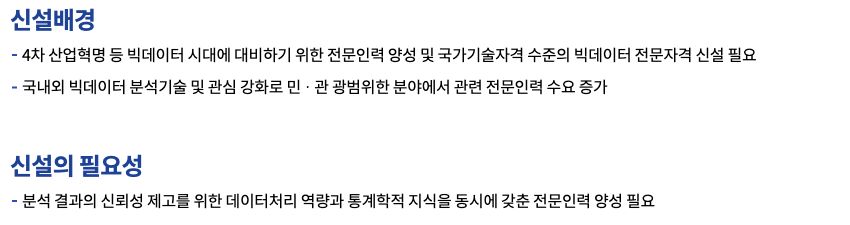
국가데이터처 공식 공개 페이지. 데이터처리와 통계 지식을 함께 평가하는 자격의 취지를 보여 준다. (출처, 2026-09-10 캡처)
취득 과정과 응시자격
응시자격 확인 → 필기 접수·응시 → 필기 합격예정 → 증빙서류 심사 → 필기 합격 확정 → 실기 접수·응시 → 최종합격 순서로 이해하면 됩니다.
학력·자격·경력 중 한 경로를 충족해야 합니다. 아래는 K-DATA 공개 서류 안내의 대표 경로를 요약한 것입니다.
| 구분 | 대표 조건 |
|---|---|
| 대학 | 대학졸업자등 또는 졸업예정자 |
| 3년제 전문대 | 졸업 후 직장경력 1년 이상 |
| 2년제 전문대 | 졸업 후 직장경력 2년 이상 |
| 기사 자격 | 기사 등급 이상 자격 취득 |
| 산업기사 | 취득 후 직장경력 1년 이상 |
| 기능사 | 취득 후 직장경력 3년 이상 |
| 경력 | 직장경력 4년 이상 |
| 기술훈련 | 기사 수준 과정 이수·이수예정 등 별도 경로 |
공개 안내에는 대학 전공, 자격 종목과 직무분야를 폭넓게 인정하는 조건이 명시돼 있습니다. 비전공자도 학력 등의 요건을 충족하면 지원할 수 있습니다. 다만 졸업예정, 학점은행제, 경력 산정은 개인별 증빙이 필요합니다. 아래 PDF는 과거 회차 문구가 남아 있는 공개 안내이므로 인정 경로를 이해하는 참고자료로 사용하고, 현재 제출기한·심사기준일은 해당 회차 공고에서 확인해야 합니다. K-DATA 응시자격 서류 안내
필기시험: 4과목, 80문항, 120분
| 과목 | 주요 내용 | 문항 |
|---|---|---|
| 빅데이터 분석기획 | 분석 계획, 데이터 수집·저장 | 20 |
| 빅데이터 탐색 | 전처리, 탐색적 분석, 통계 | 20 |
| 빅데이터 모델링 | 모형 설계, 분석기법 적용 | 20 |
| 빅데이터 결과 해석 | 모형 평가·개선, 결과 활용 | 20 |
| 합계 | 시험시간 120분 | 80 |
합격에는 전 과목 평균 60점 이상과 각 과목 40점 이상이 모두 필요합니다. 평균을 넘겨도 한 과목에서 과락이 나면 불합격입니다. 기본 시험 틀은 K-DATA 공식 안내 책자에서도 확인할 수 있으며, 오래된 책자의 세부 출제방식은 최신 공고와 구분해서 읽어야 합니다.
학습할 때는 통계의 평균·분산·확률분포·가설검정·회귀분석을 먼저 연결해 이해하세요. 그다음 선형·로지스틱 회귀, 의사결정나무, Random Forest, Boosting, SVM, 군집분석으로 확장합니다. Accuracy·Precision·Recall·F1·ROC-AUC와 RMSE·MAE가 어떤 문제에서 쓰이는지도 중요합니다. 분석 방법론, 데이터 거버넌스와 품질관리도 함께 준비합니다.
필기 점수 통과와 서류 심사는 다릅니다
점수 기준을 충족하면 먼저 필기 합격예정자가 됩니다. 졸업증명서, 경력증명서 등 자신의 경로에 맞는 서류를 정해진 기간에 제출하고 심사를 통과해야 필기 합격이 확정됩니다.
서류 미제출·불완전 제출·허위기재 또는 요건 미달은 합격예정 자격 취소 사유가 될 수 있습니다. 접수 전에 필요한 서류와 발급 소요시간을 확인하고, 제출 후에는 접수 상태와 심사 결과까지 확인하세요.
실기시험: 데이터 처리부터 모델링과 통계까지
실기는 180분 동안 Python 또는 R을 사용하며, 100점 만점에 60점 이상이 합격 기준입니다. 최근 실기 대비는 작업형 1·2·3유형으로 나누는 것이 일반적입니다.
| 준비 영역 | 연습할 내용 | 최근 구성 기준 배점 |
|---|---|---|
| 작업형 1 | 데이터 전처리·가공·계산 | 30 |
| 작업형 2 | 분류·회귀 모델 학습과 예측 | 40 |
| 작업형 3 | 통계분석·가설검정 | 30 |
이 배점은 학습 범위를 설명하기 위한 최근 구성 기준입니다. 2026년 해당 회차의 확정 문항 수·배점·세부 소문항 구성은 최신 수험자 안내에서 확인해야 합니다. 총 6문항이라는 숫자만으로 준비량을 판단하지 마세요.
작업형 1: 전처리를 코드로 완성하기
Python을 선택했다면 pandas 공식 문서를 바탕으로 파일 읽기, 조건 검색, 결측치 처리, 정렬, 그룹별 집계를 반복 연습합니다.
read_csv → 조건검색 → 결측치 처리 → 정렬 → groupby → 통계값 계산
결과를 구한 뒤 자료형, 행 수, 정렬 순서와 반올림 조건을 확인하는 습관까지 익히는 것이 좋습니다.
작업형 2: 모델 성능보다 먼저 제출 흐름 익히기
데이터를 읽고 학습·검증 데이터를 나눈 뒤 모형을 학습하고 평가하여, 별도로 제공된 테스트 데이터의 예측값을 지정 형식으로 저장합니다. scikit-learn 공식 사이트의 전처리·분류·회귀 개념을 연결해서 공부하세요.
데이터 확인 → 전처리 → 학습/검증 분리 → 학습 → 평가 → 테스트 예측 → CSV 저장
분류에는 Logistic Regression이나 Random Forest, 회귀에는 선형회귀와 트리 기반 모형 등을 연습할 수 있습니다. 전처리를 전체 데이터에 미리 학습시켜 검증 데이터 정보가 새는 실수, 예측확률 대신 클래스를 제출하는 실수, 행 순서·열 이름·인덱스 저장 실수를 특히 점검하세요. 특정 외부 패키지의 제공 여부는 시험 환경 안내를 따릅니다.
작업형 3: 계산과 해석을 함께 연습하기
t-test, 카이제곱 검정, ANOVA, 상관·회귀분석, p-value, 회귀계수와 오즈비 등을 준비합니다. 검정 이름만 외우기보다 가정, 귀무가설, 입력 데이터 형태, 결과 해석까지 연결하세요.
Python 학습 도구로는 NumPy, SciPy, statsmodels가 유용합니다. 웹의 최신 버전과 시험장 제공 버전은 다를 수 있으므로 시험 환경에 맞춰 연습해야 합니다.
2026년 시험 일정
2026년은 제12회와 제13회, 두 차례로 안내돼 있습니다. 9월 10일 현재 올해 필기시험은 모두 종료됐습니다. 새로 필기부터 시작하는 독자는 다음 연도 공고를 확인하고, 이번 필기 응시자나 유효한 필기 면제 대상자는 실기 일정을 확인하세요.
| 회차 | 필기시험 | 실기시험 | 최종합격 발표 |
|---|---|---|---|
| 제12회 | 2026-04-04 | 2026-06-20 | 2026-07-10 |
| 제13회 | 2026-09-05 | 2026-11-28 | 2026-12-18 |
제13회 필기 합격예정자 발표는 9월 23일, 실기 접수는 10월 26~30일, 실기는 11월 28일, 최종 발표는 12월 18일로 안내돼 있습니다. 응시자격 서류 제출은 실기 접수와 별개이므로 제출기간을 따로 확인해야 합니다. 국가데이터처 2026년 검정일정

국가데이터처 공식 공개 일정표. (출처, 2026-09-10 캡처) 화면의 9월 23일 요일은 ‘금’으로 표시돼 있지만 실제 2026-09-23은 수요일이다. 본문에는 날짜만 표기했다.
SQLD·ADsP와 유사 자격증 비교
K-DATA의 SQL·데이터분석·데이터아키텍처 자격은 DataQ 공식 자격 소개에서 확인할 수 있습니다. 다음 표의 분야와 학습 단계는 선택을 돕기 위한 설명이며 공식적인 통합 서열은 아닙니다.
| 자격 | 중심 분야 | 자격 성격 | 실무 평가 구분 |
|---|---|---|---|
| SQLD | SQL·데이터 모델링 기초 | 국가공인 민간자격 | 별도 실기 없음 |
| SQLP | 고급 SQL·성능 튜닝 | 국가공인 민간자격 | SQL 실기 문항 포함 |
| ADsP | 분석 기획·통계·분석 이론 | 국가공인 민간자격 | 별도 실기 없음 |
| ADP | 전문 데이터 분석 | 국가공인 민간자격 | 필기·실기 구분 |
| DAsP | 데이터 모델링·아키텍처 기초 | 등록민간자격 | 별도 실기 없음 |
| DAP | 데이터 아키텍처·설계 | 국가공인 민간자격 | 모델링 등 전문 실무 평가 |
| 빅데이터분석기사 | 통계·ML·Python/R 분석 | 국가기술자격 | 필기·실기 구분 |
| 정보처리기사 | 소프트웨어 개발·DB·시스템 | 국가기술자격 | 필기·실기 구분 |
SQLD와 SQLP: SQL 활용에서 성능 최적화로
SQLD는 데이터 모델링의 이해와 SQL 기본·활용을 공부하는 출발점입니다. 응시자격 제한이 없으며 50문항·90분, 총점 60점 이상과 과목별 과락 기준을 함께 확인해야 합니다. 최신 문항 형식은 DataQ 공고를 따르세요.
SELECT, JOIN, GROUP BY, HAVING, 서브쿼리, 윈도 함수, DML·DDL·TCL은 웹·백엔드 개발과 데이터 추출에도 연결됩니다. SQLP는 여기서 옵티마이저, 실행계획, 인덱스, 조인, 잠금·트랜잭션과 튜닝으로 깊어집니다. SQLP의 실기 문항을 빅데이터분석기사의 Python/R 작업형과 같은 방식으로 이해하면 안 됩니다. 응시자격도 별도로 확인해야 합니다.
ADsP와 ADP: 분석 이론에서 전문 분석으로
ADsP는 데이터 이해, 분석 기획, 데이터 분석을 다룹니다. 응시자격 제한과 별도 실기가 없고, 50문항·90분의 시험 틀을 갖습니다. 통계·분석 방법론이 빅데이터분석기사 필기와 겹쳐 입문 학습에 도움이 됩니다.
ADP는 분석 기획·처리·통계·머신러닝·시각화를 더 깊게 다루며 필기와 실기가 있습니다. ADsP 취득 또는 학력·경력 등 응시 경로를 확인해야 합니다. 준비 부담을 설명할 때 ADsP → 빅데이터분석기사 → ADP 순서를 제안할 수 있지만, 서로 다른 자격제도의 공식적인 상하 관계는 아닙니다.
DAsP·DAP와 정보처리기사
DAsP·DAP는 데이터 표준, 논리·물리 모델, ERD와 아키텍처에 관심이 있을 때 살펴볼 자격입니다. 예측 모형을 만드는 분석 직무보다 데이터 설계 업무에 더 가깝습니다.
정보처리기사 공식 안내는 Q-Net에서 확인합니다. 정보처리기사는 소프트웨어 개발과 시스템 구축 전반, 빅데이터분석기사는 통계와 데이터 분석에 무게를 둡니다. 같은 기사 등급이어도 준비 목적과 실기 내용이 다릅니다.
어떤 자격증부터 준비할까?
| 학습 목적 | 가능한 순서 |
|---|---|
| 개발과 데이터 추출 | SQLD → 정보처리기사 또는 빅데이터분석기사 |
| 데이터 분석 입문 | ADsP → SQLD → 빅데이터분석기사 |
| 전문 분석 역량 | SQLD·ADsP 기초 → 빅데이터분석기사 → ADP |
| 데이터 설계·DB 전문화 | SQLD → DAsP → SQLP 또는 DAP |
이 순서는 학습 제안이지 필수 취득 순서가 아닙니다. 응시자격을 갖추고 SQL·통계·프로그래밍 경험이 있다면 곧바로 빅데이터분석기사를 준비해도 됩니다. 취업 목표가 분명하다면 자격 이름보다 채용공고의 실제 업무를 먼저 보세요.
취업에서의 활용과 한계
자격증은 학습 범위를 정리하는 데 유용하지만 실무 능력 전체를 대신하지는 못합니다. SQL로 데이터를 추출하고, Python으로 분석하고, 결과와 한계를 설명하는 포트폴리오를 함께 만드는 편이 좋습니다.
공공부문에서는 자격별 점수를 명시한 채용도 있습니다. 예를 들어 국가데이터처 공고 제2026-13호는 빅데이터분석기사·SQLP·ADP 등을 5점, SQLD·ADsP 등을 3점인 자격군에 포함했습니다. 이는 해당 공고의 평가 사례이며 모든 공공기관의 공통 가점이나 취업 보장은 아닙니다.
공부 순서: 개념을 실제 데이터에 연결하기
- SQL 기초: SELECT, JOIN, GROUP BY로 데이터를 추출하고 집계합니다.
- Python 데이터 처리: 기본 문법과 pandas로 작은 CSV를 읽고 정리합니다.
- 통계: 평균·분산에서 가설검정·회귀분석으로 확장합니다.
- 머신러닝: 분류·회귀 모형을 학습하고 적절한 평가 지표를 선택합니다.
- 필기 문제풀이: 약한 과목을 찾아 과락 위험부터 줄입니다.
- 실기 시간 훈련: 처음부터 결과 파일 저장까지 제한시간 안에 반복합니다.
코드를 읽고 이해하는 것과 직접 작성하는 것은 다릅니다. 전처리 → 학습/검증 분리 → 학습 → 평가 → 예측 → CSV 출력을 스스로 완성하고, 누수·결측치·열 이름·행 순서를 점검하세요. 통계 결과를 한 문장으로 해석하는 연습도 병행합니다.
SQLD는 SQL, ADsP는 분석 이론, 빅데이터분석기사는 통계·모델링·코딩을 함께 공부하려는 사람에게 연결됩니다. 자격증 취득과 함께 실제 데이터로 재현 가능한 분석 결과를 남기는 것이 가장 중요한 학습 목표입니다.
If you are interested in data analysis or AI, you may have come across Korea’s Big Data Analysis Engineer qualification. This guide explains how it differs from SQLD and ADsP, covering eligibility, written and practical exams, certification procedures, and a study sequence suited to your goals.
Information was checked on September 10, 2026. Dates follow the Ministry of Data and Statistics’ 2026 schedule. For question formats, the exam environment, and document submission periods, always consult the official K-DATA examination notice for your session.
What is Big Data Analysis Engineer?
Big Data Analysis Engineer is a Korean national technical qualification assessing the ability to extract information from data, build analytical models, and interpret results. K-DATA administers the examination. Unlike nationally accredited private qualifications such as SQLD and ADsP, it belongs to the engineer level of the national technical qualification system.
Its scope includes analysis planning, exploration and preprocessing, statistics, machine learning, model evaluation, and interpretation. The practical exam involves processing data with Python or R. It is not simply a test of proficiency with generative AI tools.
Captured public page from the Ministry of Data and Statistics explaining why the qualification combines data processing and statistics. (Source, captured 2026-09-10)
Certification process and eligibility
Check eligibility → register for and take the written exam → provisional written pass → document review → confirmed written pass → register for and take the practical exam → final pass.
You must qualify through an education, certification, or work-experience route. The following summarizes representative routes in K-DATA’s public document guide.
| Route | Representative condition |
|---|---|
| University | Graduate or expected graduate, including recognized equivalents |
| Three-year college | Graduation followed by at least one year of work experience |
| Two-year college | Graduation followed by at least two years of work experience |
| Engineer qualification | Hold an engineer-level qualification or higher |
| Industrial engineer | Qualification followed by at least one year of work experience |
| Craftsman | Qualification followed by at least three years of work experience |
| Experience | At least four years of work experience |
| Technical training | Separate routes, including completion or expected completion of engineer-level training |
The public guide broadly recognizes majors, qualification subjects, and job fields. Non-majors can apply if they satisfy an applicable condition. Expected graduation, the Academic Credit Bank System, and experience calculations require individual evidence. The PDF below still contains wording from an earlier examination session: use it to understand eligibility routes, not current deadlines or assessment dates. Check those in your session’s notice. K-DATA eligibility document guide
Written exam: four subjects, 80 questions, 120 minutes
| Subject | Main topics | Questions |
|---|---|---|
| Big data analysis planning | Analysis plans, data collection and storage | 20 |
| Big data exploration | Preprocessing, exploratory analysis, statistics | 20 |
| Big data modeling | Model design and analytical methods | 20 |
| Interpretation of big data results | Model evaluation, improvement, and application | 20 |
| Total | 120 minutes | 80 |
Passing requires an average of at least 60 and at least 40 in every subject. A subject score below the threshold means failure even if the average is sufficient. The basic framework also appears in the official K-DATA brochure; distinguish older descriptions of question formats from current notices.
Start by connecting means, variance, probability distributions, hypothesis testing, and regression. Then study linear and logistic regression, decision trees, Random Forest, Boosting, SVM, and clustering. Understand when to use Accuracy, Precision, Recall, F1, ROC-AUC, RMSE, and MAE. Include analytical methodology, data governance, and quality management.
A passing written score is not document approval
Meeting the score requirement initially makes you a provisional successful candidate. You must submit the graduation or employment certificates relevant to your route within the designated period and pass the review before the written result is confirmed.
Missing or incomplete documents, false statements, or insufficient eligibility can cancel provisional status. Check required documents and issuance times before registering, then verify both receipt and the review result.
Practical exam: processing, modeling, and statistics
The practical exam lasts 180 minutes, uses Python or R, and requires at least 60 out of 100. Recent preparation commonly divides tasks into Types 1, 2, and 3.
| Preparation area | Practice | Points in the recent structure |
|---|---|---|
| Type 1 | Preprocessing, manipulation, and calculations | 30 |
| Type 2 | Training classification/regression models and predicting | 40 |
| Type 3 | Statistical analysis and hypothesis testing | 30 |
These figures describe a recent structure for organizing study. Confirm the definitive question count, scoring, and subquestions in the 2026 instructions for your session. Do not estimate the workload solely from the phrase “six questions.”
Type 1: complete preprocessing in code
For Python, use the official pandas documentation to practice reading files, filtering, handling missing values, sorting, and grouped aggregation.
read_csv → 조건검색 → 결측치 처리 → 정렬 → groupby → 통계값 계산
After calculating a result, check data types, row counts, sorting order, and rounding requirements.
Type 2: learn the submission workflow before optimizing performance
Read the data, split training and validation sets, train and evaluate a model, then save predictions for the separately supplied test data in the specified format. Connect preprocessing, classification, and regression concepts through the official scikit-learn website.
Inspect data → preprocess → split training/validation → train → evaluate → predict test data → save CSV.
Practice Logistic Regression or Random Forest for classification, and linear regression or tree-based models for regression. Watch for validation leakage caused by fitting preprocessing on all data, submitting classes instead of probabilities, and mistakes in row order, column names, or saved indexes. Follow the exam environment notice for available external packages.
Type 3: practice calculation and interpretation together
Prepare t-tests, chi-square tests, ANOVA, correlation and regression, p-values, regression coefficients, and odds ratios. Connect each test to its assumptions, null hypothesis, input structure, and interpretation rather than memorizing its name alone.
NumPy, SciPy, and statsmodels are useful Python learning tools. Online releases may differ from those provided in the exam, so practice with the specified environment.
2026 exam schedule
The 2026 schedule lists two sessions, the 12th and 13th. As of September 10, both written exams for this year have finished. New written-exam candidates should check next year’s announcement; candidates from this session and those with a valid written-exam exemption should check the practical schedule.
| Session | Written exam | Practical exam | Final results |
|---|---|---|---|
| 12th | 2026-04-04 | 2026-06-20 | 2026-07-10 |
| 13th | 2026-09-05 | 2026-11-28 | 2026-12-18 |
For the 13th session, provisional written results are scheduled for September 23, practical registration for October 26–30, the practical exam for November 28, and final results for December 18. Eligibility document submission is separate from practical registration; check its deadline independently. Official 2026 examination schedule
Official public schedule from the Ministry of Data and Statistics. (Source, captured 2026-09-10) The screenshot labels September 23 as Friday, but 2026-09-23 is Wednesday. Only dates are used in the article.
Comparing SQLD, ADsP, and related qualifications
See DataQ’s official qualification introduction for K-DATA’s SQL, analysis, and architecture qualifications. The focus areas and learning stages below help with selection; they are not an official ranking.
| Qualification | Main focus | Status in Korea | Practical assessment |
|---|---|---|---|
| SQLD | SQL and basic data modeling | Nationally accredited private qualification | No separate practical exam |
| SQLP | Advanced SQL and performance tuning | Nationally accredited private qualification | Includes SQL practical questions |
| ADsP | Planning, statistics, and analysis theory | Nationally accredited private qualification | No separate practical exam |
| ADP | Professional data analysis | Nationally accredited private qualification | Separate written and practical exams |
| DAsP | Basic data modeling and architecture | Registered private qualification | No separate practical exam |
| DAP | Data architecture and design | Nationally accredited private qualification | Professional tasks including modeling |
| Big Data Analysis Engineer | Statistics, ML, and Python/R analysis | National technical qualification | Separate written and practical exams |
| Information Processing Engineer | Software development, databases, systems | National technical qualification | Separate written and practical exams |
SQLD and SQLP: from SQL usage to performance optimization
SQLD is a starting point for data modeling and basic/applied SQL. It has no eligibility restrictions and a framework of 50 questions in 90 minutes. Check both the overall passing score of 60 and the subject minimums. Current question formats follow DataQ notices.
SELECT, JOIN, GROUP BY, HAVING, subqueries, window functions, and DML/DDL/TCL also apply to web/backend development and data extraction. SQLP goes deeper into optimizers, execution plans, indexes, joins, locks, transactions, and tuning. Its SQL practical questions are not the same format as Python/R tasks in Big Data Analysis Engineer. Check its separate eligibility requirements too.
ADsP and ADP: from theory to professional analysis
ADsP covers data understanding, analysis planning, and analysis. It has no eligibility restriction or separate practical exam, with a framework of 50 questions in 90 minutes. Its statistics and methodology overlap with the Big Data Analysis Engineer written exam and can support introductory study.
ADP explores planning, processing, statistics, machine learning, and visualization more deeply, with written and practical exams. Check eligibility routes such as holding ADsP or meeting education/experience criteria. ADsP → Big Data Analysis Engineer → ADP can be a suggested progression in preparation effort, but it is not an official hierarchy across these systems.
DAsP, DAP, and Information Processing Engineer
DAsP and DAP are worth exploring for data standards, logical/physical models, ERDs, and architecture. They are closer to data design work than to predictive modeling roles.
See Q-Net’s official Information Processing Engineer guide. That qualification covers software development and systems more broadly, while Big Data Analysis Engineer emphasizes statistics and analysis. Sharing the engineer level does not mean identical goals or practical content.
Which qualification should come first?
| Learning goal | Possible sequence |
|---|---|
| Development and data extraction | SQLD → Information Processing Engineer or Big Data Analysis Engineer |
| Introduction to data analysis | ADsP → SQLD → Big Data Analysis Engineer |
| Professional analysis | SQLD/ADsP foundations → Big Data Analysis Engineer → ADP |
| Data design and database specialization | SQLD → DAsP → SQLP or DAP |
These are study suggestions, not mandatory prerequisites. If you are eligible and already know SQL, statistics, and programming, you can prepare directly for Big Data Analysis Engineer. With a clear employment goal, examine the actual duties in job postings before focusing on qualification names.
Employment value and limitations
A qualification helps organize learning but cannot represent all practical ability. Build a portfolio that extracts data with SQL, analyzes it with Python, and explains results and limitations.
Some public-sector recruitment assigns qualification points. For example, Ministry of Data and Statistics Notice 2026-13 placed Big Data Analysis Engineer, SQLP, and ADP in a five-point group, and SQLD and ADsP in a three-point group. This is one posting’s assessment example, not a universal public-sector bonus or an employment guarantee.
Study sequence: connect concepts to real data
- SQL basics: extract and aggregate with SELECT, JOIN, and GROUP BY.
- Python data processing: read and clean a small CSV using basic syntax and pandas.
- Statistics: progress from means and variance to hypothesis testing and regression.
- Machine learning: train classification/regression models and choose suitable metrics.
- Written practice: identify weak subjects and reduce the risk of subject-level failure.
- Timed practical practice: repeat the entire workflow through saving the output file within the time limit.
Reading code is different from writing it yourself. Complete preprocessing → training/validation split → training → evaluation → prediction → CSV output, checking leakage, missing values, column names, and row order. Practice explaining statistical results in one sentence too.
SQLD supports SQL study, ADsP analysis theory, and Big Data Analysis Engineer the combination of statistics, modeling, and coding. Alongside certification, producing reproducible analysis of real data is the most important learning goal.
对数据分析或AI感兴趣的人,可能听说过韩国的大数据分析工程师(빅데이터분석기사)资格。本文介绍它与SQLD、ADsP的区别,从报考条件、笔试和实操到最终取证流程,帮助你根据学习目标安排准备顺序。
本文信息核对日期为2026年9月10日,日程依据韩国国家数据处公布的2026年安排。具体题型、考试环境和材料提交期限,请以当次考试的K-DATA官方公告为准。
什么是大数据分析工程师?
这是评估从数据中提取信息、建立分析模型并解释结果能力的韩国国家技术资格,由韩国数据产业振兴院(K-DATA)实施考试。它属于国家技术资格的기사级别,与SQLD、ADsP等国家认可的民间资格不同。
内容涵盖分析规划、数据探索与预处理、统计、机器学习、模型评价和结果解释。实操使用Python或R处理真实数据,并不是单纯考查生成式AI工具使用能力。
国家数据处官方公开页面,说明该资格同时重视数据处理与统计知识的设立目的。(来源,截图日期:2026-09-10)
取证流程与报考条件
确认资格 → 笔试报名与考试 → 笔试预合格 → 证明材料审核 → 确认笔试合格 → 实操报名与考试 → 最终合格。
需要满足学历、资格或工作经历中的一条路径。下表概括K-DATA公开材料指南中的代表条件。
| 路径 | 代表条件 |
|---|---|
| 大学 | 大学毕业生、同等认可人员或预计毕业生 |
| 三年制专科 | 毕业后至少1年工作经历 |
| 两年制专科 | 毕业后至少2年工作经历 |
| 기사资格 | 已取得기사级或更高级资格 |
| 产业기사 | 取得资格后至少1年工作经历 |
| 技能士 | 取得资格后至少3年工作经历 |
| 工作经历 | 至少4年工作经历 |
| 技术培训 | 完成或预计完成기사水平培训等其他路径 |
公开指南对大学专业、资格类别和工作领域采用较广的认可范围,非相关专业人员满足学历等条件也可申请。但预计毕业、学分银行制和经历计算需要个人证明。以下PDF仍保留旧考试批次的文字,应作为理解资格路径的参考;当前提交期限和审核基准日必须查询当次公告。K-DATA报考资格材料指南
笔试:4科、80题、120分钟
| 科目 | 主要内容 | 题数 |
|---|---|---|
| 大数据分析规划 | 分析计划、数据收集与存储 | 20 |
| 大数据探索 | 预处理、探索性分析、统计 | 20 |
| 大数据建模 | 模型设计、分析方法应用 | 20 |
| 大数据结果解释 | 模型评价与改进、结果应用 | 20 |
| 合计 | 考试时间120分钟 | 80 |
合格须同时达到各科平均60分以上、每科40分以上。即使平均达标,单科不足也会不合格。基本框架可参见K-DATA官方手册,但旧手册的具体题型应与最新公告区分。
先理解均值、方差、概率分布、假设检验和回归的关联,再学习线性与逻辑回归、决策树、Random Forest、Boosting、SVM和聚类。还应掌握Accuracy、Precision、Recall、F1、ROC-AUC以及RMSE、MAE的适用场景,并准备分析方法论、数据治理与质量管理。
笔试分数达标不等于材料审核通过
达到分数线后,首先成为笔试预合格者。须在规定时间内提交对应路径的毕业证明、工作证明等材料,通过审核后才确认笔试合格。
未提交、材料不完整、虚假填写或资格不足,都可能取消预合格状态。报名之前确认材料及开具所需时间,提交后还要检查收件状态和审核结果。
实操:从数据处理到建模与统计
实操使用Python或R,时长180分钟,满分100分,60分以上合格。近期备考通常分为操作型1、2、3三个类型。
| 准备领域 | 练习内容 | 近期结构参考分值 |
|---|---|---|
| 类型1 | 数据预处理、加工、计算 | 30 |
| 类型2 | 分类与回归模型训练、预测 | 40 |
| 类型3 | 统计分析与假设检验 | 30 |
这些分值是用于说明学习范围的近期结构参考。2026年具体批次的最终题数、分值及小题组成,请查看最新考生指南。不要仅凭“共6题”判断准备工作量。
类型1:用代码完成预处理
选择Python时,可参考pandas官方文档,反复练习文件读取、条件筛选、缺失值处理、排序与分组汇总。
read_csv → 조건검색 → 결측치 처리 → 정렬 → groupby → 통계값 계산
计算后养成检查数据类型、行数、排序顺序和四舍五入要求的习惯。
类型2:先掌握提交流程,再优化模型性能
读取数据,划分训练与验证集,训练并评价模型,然后把单独提供的测试数据预测值保存为指定格式。结合scikit-learn官网学习预处理、分类与回归概念。
检查数据 → 预处理 → 划分训练/验证集 → 训练 → 评价 → 测试集预测 → 保存CSV。
分类可练习Logistic Regression或Random Forest,回归可练习线性回归与树模型。尤其注意在全体数据上拟合预处理造成验证信息泄漏、把类别当作预测概率提交,以及行顺序、列名和索引保存错误。外部软件包是否可用,以考试环境说明为准。
类型3:计算与解释一起练习
准备t-test、卡方检验、ANOVA、相关与回归分析、p-value、回归系数和优势比。不要只背检验名称,要把前提假设、原假设、输入数据形式和结果解释联系起来。
NumPy、SciPy和statsmodels可用于Python学习。网上最新版本可能与考场版本不同,应按考试环境练习。
2026年考试日程
2026年公布了第12和第13两次考试。截至9月10日,今年的两次笔试均已结束。从笔试开始的新考生应关注下一年度公告;本次笔试考生及具有有效笔试免考资格者应查看实操安排。
| 批次 | 笔试 | 实操 | 最终结果 |
|---|---|---|---|
| 第12次 | 2026-04-04 | 2026-06-20 | 2026-07-10 |
| 第13次 | 2026-09-05 | 2026-11-28 | 2026-12-18 |
第13次笔试预合格公布日为9月23日,实操报名为10月26日至30日,实操为11月28日,最终结果为12月18日。资格材料提交与实操报名是不同事项,须单独确认期限。国家数据处2026年考试日程
国家数据处官方公开日程表。(来源,截图日期:2026-09-10)截图将9月23日标为周五,但2026-09-23实际是周三,因此正文仅使用日期。
SQLD、ADsP与相关资格比较
K-DATA的SQL、数据分析和数据架构资格可见DataQ官方资格介绍。下表的领域和学习阶段仅供选择参考,并非官方统一排名。
| 资格 | 重点领域 | 韩国资格性质 | 实践评价方式 |
|---|---|---|---|
| SQLD | SQL与数据建模基础 | 国家认可民间资格 | 无独立实操 |
| SQLP | 高级SQL与性能调优 | 国家认可民间资格 | 包含SQL实操题 |
| ADsP | 分析规划、统计与理论 | 国家认可民间资格 | 无独立实操 |
| ADP | 专业数据分析 | 国家认可民间资格 | 分笔试与实操 |
| DAsP | 数据建模与架构基础 | 登记民间资格 | 无独立实操 |
| DAP | 数据架构与设计 | 国家认可民间资格 | 建模等专业实践评价 |
| 大数据分析工程师 | 统计、ML、Python/R分析 | 国家技术资格 | 分笔试与实操 |
| 信息处理기사 | 软件开发、数据库与系统 | 国家技术资格 | 分笔试与实操 |
SQLD与SQLP:从SQL应用到性能优化
SQLD是学习数据建模、SQL基础与应用的起点,没有报考资格限制,基本框架为50题、90分钟,须同时注意总分60分和各科最低分要求。最新题型以DataQ公告为准。
SELECT、JOIN、GROUP BY、HAVING、子查询、窗口函数及DML、DDL、TCL也用于Web/后端开发和数据提取。SQLP进一步深入优化器、执行计划、索引、连接、锁、事务与调优。其SQL实操题并不等同于大数据分析工程师的Python/R操作型题目,报考资格也须另行核对。
ADsP与ADP:从分析理论到专业分析
ADsP包括数据理解、分析规划和数据分析,无报考资格限制和独立实操,基本框架为50题、90分钟。统计和方法论与大数据分析工程师笔试有重合,有助于入门。
ADP更深入地考查规划、处理、统计、机器学习和可视化,分笔试与实操。须确认持有ADsP或学历、经历等报考路径。按准备负担可建议ADsP → 大数据分析工程师 → ADP,但不同资格制度之间并没有这样的官方上下级关系。
DAsP、DAP与信息处理기사
对数据标准、逻辑/物理模型、ERD及架构感兴趣,可关注DAsP和DAP。它们更接近数据设计工作,而非预测建模岗位。
信息处理기사官方指南见Q-Net。它侧重软件开发和系统建设整体,大数据分析工程师则侧重统计与分析。即使同为기사级别,准备目标和实操内容也不同。
应先准备哪项资格?
| 学习目标 | 可选顺序 |
|---|---|
| 开发与数据提取 | SQLD → 信息处理기사或大数据分析工程师 |
| 数据分析入门 | ADsP → SQLD → 大数据分析工程师 |
| 专业分析能力 | SQLD/ADsP基础 → 大数据分析工程师 → ADP |
| 数据设计与数据库专业化 | SQLD → DAsP → SQLP或DAP |
这只是学习建议,不是强制取证顺序。满足资格且已有SQL、统计和编程经验,可直接准备大数据分析工程师。求职目标明确时,应先看招聘岗位的实际工作,而非只看资格名称。
求职价值与局限
资格有助于梳理学习范围,但不能替代全部实践能力。建议同时制作作品集:用SQL提取数据,用Python分析,并说明结果与局限。
部分公共部门招聘会为资格赋分。例如国家数据处第2026-13号公告将大数据分析工程师、SQLP、ADP等列入5分组,SQLD、ADsP等列入3分组。这只是该公告的评价案例,并非所有公共机构的通用加分或就业保证。
学习顺序:把概念连接到真实数据
- SQL基础:用SELECT、JOIN、GROUP BY提取和汇总数据。
- Python数据处理:用基本语法和pandas读取、整理小型CSV。
- 统计:从均值、方差扩展到假设检验与回归。
- 机器学习:训练分类、回归模型并选择合适指标。
- 笔试练习:找到薄弱科目,先降低单科不达标风险。
- 实操限时训练:在时限内反复完成从开始到保存结果文件的全过程。
看懂代码与亲手编写不同。独立完成预处理 → 训练/验证划分 → 训练 → 评价 → 预测 → CSV输出,检查泄漏、缺失值、列名和行顺序,同时练习用一句话解释统计结果。
SQLD对应SQL学习,ADsP对应分析理论,大数据分析工程师则结合统计、建模与编程。取得资格的同时,用真实数据留下可复现的分析成果,才是最重要的学习目标。
データ分析やAIに関心があると、韓国のビッグデータ分析技師(빅데이터분석기사)という資格を目にすることがあります。SQLD・ADsPとの違い、受験資格、筆記・実技、取得までの手続きを整理し、目的に合った学習順序を考えます。
情報の確認日は2026年9月10日です。日程は韓国の国家データ処の2026年案内に基づきます。出題構成、試験環境、書類提出期間は、受験回のK-DATA公式公告を最終的な基準として確認してください。
ビッグデータ分析技師とは?
データから必要な情報を抽出し、分析モデルを作り、結果を解釈する能力を評価する韓国の国家技術資格です。韓国データ産業振興院(K-DATA)が試験を実施します。SQLD・ADsPのような国家公認民間資格とは異なり、国家技術資格の技師等級に属します。
分析企画、データ探索・前処理、統計、機械学習、モデル評価と結果解釈を扱います。実技ではPythonまたはRで実際のデータを処理します。生成AIツールの操作だけを評価する試験ではありません。
国家データ処の公式公開ページ。データ処理と統計の両方を評価する資格の趣旨を示しています。(出典、2026-09-10撮影)
取得手順と受験資格
受験資格確認 → 筆記申込・受験 → 筆記合格予定 → 証明書類審査 → 筆記合格確定 → 実技申込・受験 → 最終合格という流れです。
学歴・資格・職歴のいずれかの経路を満たす必要があります。以下はK-DATAの公開書類案内にある代表的な経路です。
| 区分 | 代表的な条件 |
|---|---|
| 大学 | 大学卒業者等、または卒業予定者 |
| 3年制専門大学 | 卒業後1年以上の職歴 |
| 2年制専門大学 | 卒業後2年以上の職歴 |
| 技師資格 | 技師等級以上の資格取得 |
| 産業技師 | 取得後1年以上の職歴 |
| 技能士 | 取得後3年以上の職歴 |
| 職歴 | 4年以上の職歴 |
| 技術訓練 | 技師水準の課程修了・修了予定などの別経路 |
公開案内では大学の専攻、資格種目、職務分野を幅広く認めています。非専攻者も学歴などの条件を満たせば申請可能です。ただし、卒業予定、学点銀行制、職歴計算には個別の証明が必要です。以下のPDFには過去の試験回の記述が残っているため、資格経路を理解する参考資料として使い、現在の提出期限や審査基準日は当該回の公告で確認してください。K-DATA受験資格書類案内
筆記試験:4科目・80問・120分
| 科目 | 主な内容 | 問題数 |
|---|---|---|
| ビッグデータ分析企画 | 分析計画、データ収集・保存 | 20 |
| ビッグデータ探索 | 前処理、探索的分析、統計 | 20 |
| ビッグデータモデリング | モデル設計、分析手法の適用 | 20 |
| ビッグデータ結果解釈 | モデル評価・改善、結果活用 | 20 |
| 合計 | 試験時間120分 | 80 |
合格には全科目平均60点以上、かつ各科目40点以上が必要です。平均を超えても1科目が基準未満なら不合格です。基本構成はK-DATA公式冊子でも確認できますが、古い冊子の詳細な出題方式と最新公告は区別してください。
平均・分散・確率分布・仮説検定・回帰分析を関連づけて理解し、線形・ロジスティック回帰、決定木、Random Forest、Boosting、SVM、クラスタリングへ広げます。Accuracy・Precision・Recall・F1・ROC-AUC、RMSE・MAEの使い分けも重要です。分析方法論、データガバナンス、品質管理も準備します。
筆記の得点基準達成と書類審査は別です
得点基準を満たすと、まず筆記合格予定者になります。卒業証明書や職歴証明書など、自分の経路に対応する書類を期限内に提出し、審査に通って初めて筆記合格が確定します。
未提出、不備、虚偽記載、要件不足は合格予定の取消理由になり得ます。申込前に必要書類と発行日数を確認し、提出後も受領状況と審査結果を確認しましょう。
実技試験:データ処理からモデルと統計まで
実技はPythonまたはRを使う180分の試験で、100点満点中60点以上が合格基準です。最近の対策では作業型1・2・3に分けるのが一般的です。
| 準備領域 | 練習内容 | 最近の構成による参考配点 |
|---|---|---|
| 作業型1 | データ前処理・加工・計算 | 30 |
| 作業型2 | 分類・回帰モデルの学習と予測 | 40 |
| 作業型3 | 統計分析・仮説検定 | 30 |
これは学習範囲を説明するための最近の構成です。2026年の受験回の確定問題数、配点、小問構成は最新の受験者案内で確認してください。「合計6問」という数字だけで準備量を判断しないでください。
作業型1:前処理をコードで完成させる
Pythonを選ぶ場合はpandas公式ドキュメントを使い、ファイル読込、条件抽出、欠損処理、並べ替え、グループ集計を繰り返し練習します。
read_csv → 조건검색 → 결측치 처리 → 정렬 → groupby → 통계값 계산
結果を求めた後に、データ型、行数、並び順、丸め条件を確認する習慣もつけましょう。
作業型2:性能改善の前に提出の流れを覚える
データを読み、学習・検証用に分割してモデルを学習・評価し、別途提供されるテストデータの予測を指定形式で保存します。scikit-learn公式サイトの前処理・分類・回帰を関連づけて学びましょう。
データ確認 → 前処理 → 学習/検証分割 → 学習 → 評価 → テスト予測 → CSV保存。
分類はLogistic RegressionやRandom Forest、回帰は線形回帰や木ベースのモデルを練習できます。全データで前処理を学習させることによる情報漏洩、予測確率の代わりにクラスを提出するミス、行順・列名・インデックス保存ミスに注意してください。外部パッケージの提供状況は試験環境案内に従います。
作業型3:計算と解釈を一緒に練習する
t-test、カイ二乗検定、ANOVA、相関・回帰分析、p-value、回帰係数、オッズ比などを準備します。検定名だけでなく、前提、帰無仮説、入力データの形、結果解釈を結びつけます。
Pythonの学習にはNumPy、SciPy、statsmodelsが役立ちます。Web上の最新版と試験環境の版は異なる場合があるため、提供環境に合わせて練習してください。
2026年の試験日程
2026年は第12回と第13回の2回が案内されています。9月10日時点で今年の筆記試験はすべて終了しています。新たに筆記から始める方は次年度の公告を、今回の受験者や有効な筆記免除対象者は実技日程を確認してください。
| 回 | 筆記 | 実技 | 最終合格発表 |
|---|---|---|---|
| 第12回 | 2026-04-04 | 2026-06-20 | 2026-07-10 |
| 第13回 | 2026-09-05 | 2026-11-28 | 2026-12-18 |
第13回の筆記合格予定発表は9月23日、実技申込は10月26〜30日、実技は11月28日、最終発表は12月18日です。受験資格書類の提出は実技申込とは別なので、期限を個別に確認してください。国家データ処の2026年試験日程
国家データ処の公式公開日程表。(出典、2026-09-10撮影)画面では9月23日が金曜日と表示されていますが、2026-09-23は水曜日です。本文では日付のみを記載しています。
SQLD・ADsPと関連資格の比較
K-DATAのSQL・分析・アーキテクチャ資格はDataQ公式資格紹介で確認できます。以下の分野や学習段階は選択のための説明で、公式な総合順位ではありません。
| 資格 | 中心分野 | 韓国での資格区分 | 実務評価 |
|---|---|---|---|
| SQLD | SQL・データモデリング基礎 | 国家公認民間資格 | 独立した実技なし |
| SQLP | 高度なSQL・性能チューニング | 国家公認民間資格 | SQL実技問題を含む |
| ADsP | 分析企画・統計・理論 | 国家公認民間資格 | 独立した実技なし |
| ADP | 専門的データ分析 | 国家公認民間資格 | 筆記・実技を区分 |
| DAsP | モデリング・アーキテクチャ基礎 | 登録民間資格 | 独立した実技なし |
| DAP | データアーキテクチャ・設計 | 国家公認民間資格 | モデリングなどの専門実務評価 |
| ビッグデータ分析技師 | 統計・ML・Python/R分析 | 国家技術資格 | 筆記・実技を区分 |
| 情報処理技師 | ソフトウェア開発・DB・システム | 国家技術資格 | 筆記・実技を区分 |
SQLDとSQLP:SQL活用から性能最適化へ
SQLDはデータモデリングとSQLの基本・活用を学ぶ出発点です。受験資格制限はなく、50問・90分の構成で、総点60点以上と科目別最低点の両方を確認します。最新の問題形式はDataQ公告に従ってください。
SELECT、JOIN、GROUP BY、HAVING、サブクエリ、ウィンドウ関数、DML・DDL・TCLはWeb・バックエンド開発やデータ抽出にもつながります。SQLPではオプティマイザ、実行計画、インデックス、結合、ロック・トランザクション、チューニングを深く扱います。SQL実技問題はビッグデータ分析技師のPython/R作業型とは異なります。受験資格も別途確認が必要です。
ADsPとADP:分析理論から専門分析へ
ADsPはデータ理解、分析企画、データ分析を扱います。受験資格制限と独立した実技はなく、50問・90分の構成です。統計や方法論はビッグデータ分析技師の筆記と重なり、入門学習に役立ちます。
ADPは企画・処理・統計・機械学習・可視化をさらに深く扱い、筆記と実技があります。ADsP取得や学歴・職歴などの受験経路を確認してください。準備負担の目安としてADsP → ビッグデータ分析技師 → ADPと提案できますが、異なる制度間の公式な上下関係ではありません。
DAsP・DAPと情報処理技師
DAsP・DAPはデータ標準、論理・物理モデル、ERD、アーキテクチャに関心がある場合の候補です。予測モデルを作る分析職より、データ設計の仕事に近い資格です。
情報処理技師の公式案内はQ-Netにあります。情報処理技師は開発・システム構築全般、ビッグデータ分析技師は統計・分析に重点を置きます。同じ技師等級でも目的と実技内容は異なります。
どの資格から準備する?
| 学習目的 | 順序の例 |
|---|---|
| 開発とデータ抽出 | SQLD → 情報処理技師またはビッグデータ分析技師 |
| データ分析入門 | ADsP → SQLD → ビッグデータ分析技師 |
| 専門分析能力 | SQLD・ADsP基礎 → ビッグデータ分析技師 → ADP |
| データ設計・DB専門化 | SQLD → DAsP → SQLPまたはDAP |
これは学習上の提案であり、必須の取得順序ではありません。受験資格を満たしSQL・統計・プログラミング経験があれば、直接ビッグデータ分析技師を準備できます。就職目標が明確なら、資格名より先に求人の実際の業務を確認しましょう。
就職での活用と限界
資格は学習範囲の整理に有効ですが、実務能力全体を代替するものではありません。SQLで抽出し、Pythonで分析し、結果と限界を説明するポートフォリオも作りましょう。
公共部門には資格別配点を示す採用もあります。例えば国家データ処公告第2026-13号では、ビッグデータ分析技師・SQLP・ADPなどが5点、SQLD・ADsPなどが3点の資格群に含まれます。これはその公告の評価例で、すべての公共機関に共通の加点や就職保証ではありません。
学習順序:概念を実データにつなぐ
- SQL基礎:SELECT、JOIN、GROUP BYで抽出・集計します。
- Pythonデータ処理:基本構文とpandasで小さなCSVを読み、整理します。
- 統計:平均・分散から仮説検定・回帰へ進みます。
- 機械学習:分類・回帰モデルを学習し、適切な指標を選びます。
- 筆記演習:弱い科目を見つけ、科目別不合格のリスクを減らします。
- 実技の時間練習:開始から結果ファイル保存までを制限時間内に繰り返します。
コードを読むことと自分で書くことは異なります。前処理 → 学習/検証分割 → 学習 → 評価 → 予測 → CSV出力を自力で完成させ、漏洩、欠損値、列名、行順を確認しましょう。統計結果を一文で解釈する練習も行います。
SQLDはSQL、ADsPは分析理論、ビッグデータ分析技師は統計・モデリング・コーディングを一緒に学びたい人に対応します。資格取得とともに、実データで再現可能な分析結果を残すことが最も重要な学習目標です。
Si te interesa el análisis de datos o la IA, quizá hayas encontrado la certificación coreana Big Data Analysis Engineer. Esta guía explica sus diferencias con SQLD y ADsP, los requisitos, los exámenes y el proceso de obtención, para organizar el estudio según tus objetivos.
La información se comprobó el 10 de septiembre de 2026. Las fechas siguen el calendario del Ministerio de Datos y Estadística de Corea. Para el formato, el entorno de examen y los plazos documentales, consulta siempre el anuncio oficial de K-DATA de tu convocatoria.
¿Qué es Big Data Analysis Engineer?
Es una cualificación técnica nacional de Corea que evalúa la capacidad de extraer información, construir modelos analíticos e interpretar resultados. K-DATA administra el examen. Pertenece al nivel de ingeniero del sistema técnico nacional, a diferencia de certificaciones privadas acreditadas por el Estado como SQLD y ADsP.
Incluye planificación, exploración y preprocesamiento, estadística, aprendizaje automático, evaluación e interpretación. La práctica utiliza Python o R para procesar datos reales. No es simplemente una prueba de manejo de herramientas de IA generativa.
Página pública oficial del Ministerio de Datos y Estadística que explica el propósito de combinar procesamiento de datos y estadística. (Fuente, captura: 2026-09-10)
Proceso y requisitos de acceso
Comprobar requisitos → inscripción y examen escrito → aprobado provisional → revisión documental → aprobado escrito confirmado → inscripción y prueba práctica → aprobado final.
Debes cumplir una vía académica, profesional o de certificación. La tabla resume vías representativas de la guía pública de K-DATA.
| Vía | Condición representativa |
|---|---|
| Universidad | Titulación universitaria, equivalencia reconocida o graduación prevista |
| Centro superior de tres años | Graduación y al menos un año de experiencia laboral |
| Centro superior de dos años | Graduación y al menos dos años de experiencia laboral |
| Cualificación de ingeniero | Poseer una cualificación de ese nivel o superior |
| Ingeniero industrial técnico | Cualificación seguida de al menos un año de experiencia |
| Nivel de técnico artesano | Cualificación seguida de al menos tres años de experiencia |
| Experiencia | Al menos cuatro años de experiencia laboral |
| Formación técnica | Otras vías, como completar o prever completar formación de nivel de ingeniero |
La guía reconoce ampliamente especialidades académicas, categorías de certificación y campos laborales. También pueden solicitarla personas de otras especialidades que cumplan los requisitos. La graduación prevista, el sistema coreano de créditos académicos y el cálculo de experiencia requieren pruebas individuales. El PDF siguiente conserva referencias a una convocatoria antigua: úsalo para entender las vías, no los plazos actuales ni la fecha de evaluación de requisitos. Consulta estos últimos en el anuncio correspondiente. Guía documental de K-DATA
Examen escrito: cuatro materias, 80 preguntas y 120 minutos
| Materia | Contenido principal | Preguntas |
|---|---|---|
| Planificación del análisis de big data | Planes, recopilación y almacenamiento | 20 |
| Exploración de big data | Preprocesamiento, exploración y estadística | 20 |
| Modelado de big data | Diseño de modelos y métodos analíticos | 20 |
| Interpretación de resultados | Evaluación, mejora y aplicación | 20 |
| Total | 120 minutos | 80 |
Se exige una media mínima de 60 y al menos 40 en cada materia. Una materia por debajo del mínimo implica suspender aunque la media sea suficiente. El marco básico figura en el folleto oficial de K-DATA; distingue sus descripciones antiguas de formato de los anuncios actuales.
Relaciona primero media, varianza, distribuciones, contraste de hipótesis y regresión. Después estudia regresión lineal y logística, árboles, Random Forest, Boosting, SVM y agrupamiento. Comprende cuándo usar Accuracy, Precision, Recall, F1, ROC-AUC, RMSE y MAE. Incluye metodología analítica, gobernanza y calidad de datos.
Superar la puntuación escrita no equivale a aprobar la revisión documental
Al alcanzar la puntuación requerida obtienes inicialmente un aprobado provisional. Debes presentar certificados académicos o laborales correspondientes a tu vía dentro del plazo y superar la revisión para confirmar el aprobado escrito.
La falta de documentos, los expedientes incompletos, las declaraciones falsas o los requisitos insuficientes pueden anular ese estado. Comprueba documentos y tiempos de expedición antes de inscribirte; después verifica la recepción y el resultado de la revisión.
Prueba práctica: procesamiento, modelos y estadística
La prueba dura 180 minutos, utiliza Python o R y exige al menos 60 puntos sobre 100. La preparación reciente suele dividirse en tareas de tipos 1, 2 y 3.
| Área | Contenido de práctica | Puntos de la estructura reciente |
|---|---|---|
| Tipo 1 | Preprocesamiento, manipulación y cálculos | 30 |
| Tipo 2 | Entrenamiento y predicción con clasificación/regresión | 40 |
| Tipo 3 | Análisis estadístico y contrastes de hipótesis | 30 |
Las cifras describen una estructura reciente para organizar el estudio. Confirma el número definitivo de preguntas, la puntuación y los apartados en las instrucciones de tu convocatoria de 2026. No calcules el trabajo necesario únicamente a partir de “seis preguntas”.
Tipo 1: completar el preprocesamiento con código
Si eliges Python, utiliza la documentación oficial de pandas para practicar lectura de archivos, filtrado, valores ausentes, ordenación y agregaciones por grupos.
read_csv → 조건검색 → 결측치 처리 → 정렬 → groupby → 통계값 계산
Después del cálculo, comprueba tipos de datos, número de filas, orden y requisitos de redondeo.
Tipo 2: aprender el flujo de entrega antes de optimizar el rendimiento
Lee los datos, separa entrenamiento y validación, entrena y evalúa el modelo, y guarda las predicciones del conjunto de prueba suministrado por separado en el formato solicitado. Relaciona preprocesamiento, clasificación y regresión con la web oficial de scikit-learn.
Inspeccionar datos → preprocesar → separar entrenamiento/validación → entrenar → evaluar → predecir prueba → guardar CSV.
Practica Logistic Regression o Random Forest para clasificación, y regresión lineal o modelos de árboles para regresión. Vigila las fugas de información por ajustar el preprocesamiento con todos los datos, la entrega de clases en lugar de probabilidades y los errores de orden, nombres de columnas o índices guardados. La disponibilidad de paquetes externos depende del entorno anunciado.
Tipo 3: practicar cálculo e interpretación juntos
Prepara t-test, chi-cuadrado, ANOVA, correlación y regresión, p-value, coeficientes y razones de momios. Relaciona cada prueba con sus supuestos, hipótesis nula, formato de entrada e interpretación, en vez de memorizar únicamente su nombre.
NumPy, SciPy y statsmodels son útiles para estudiar con Python. Las versiones disponibles en el examen pueden diferir de las últimas versiones web: practica con el entorno indicado.
Calendario de 2026
Se anuncian dos convocatorias, la 12.ª y la 13.ª. A 10 de septiembre, ambos exámenes escritos del año ya han terminado. Quienes empiecen por el escrito deben consultar el anuncio del próximo año; quienes hayan participado o tengan una exención válida deben revisar las fechas prácticas.
| Convocatoria | Escrito | Práctica | Resultados finales |
|---|---|---|---|
| 12.ª | 2026-04-04 | 2026-06-20 | 2026-07-10 |
| 13.ª | 2026-09-05 | 2026-11-28 | 2026-12-18 |
Para la 13.ª convocatoria, los resultados escritos provisionales se anuncian para el 23 de septiembre, la inscripción práctica para el 26–30 de octubre, la práctica para el 28 de noviembre y los resultados finales para el 18 de diciembre. La entrega documental es independiente de la inscripción práctica; comprueba su plazo por separado. Calendario oficial de 2026
Calendario público oficial del Ministerio de Datos y Estadística. (Fuente, captura: 2026-09-10) La imagen indica viernes para el 23 de septiembre, pero 2026-09-23 es miércoles. El texto utiliza solamente las fechas.
Comparación con SQLD, ADsP y otras certificaciones
Consulta la presentación oficial de DataQ para las certificaciones SQL, análisis y arquitectura de K-DATA. Los campos y etapas siguientes orientan la elección; no son una clasificación oficial conjunta.
| Certificación | Enfoque | Categoría en Corea | Evaluación práctica |
|---|---|---|---|
| SQLD | SQL y modelado básico de datos | Privada acreditada por el Estado | Sin práctica independiente |
| SQLP | SQL avanzado y optimización | Privada acreditada por el Estado | Incluye preguntas prácticas de SQL |
| ADsP | Planificación, estadística y teoría | Privada acreditada por el Estado | Sin práctica independiente |
| ADP | Análisis profesional de datos | Privada acreditada por el Estado | Escrito y práctica separados |
| DAsP | Modelado y arquitectura básicos | Privada registrada | Sin práctica independiente |
| DAP | Arquitectura y diseño de datos | Privada acreditada por el Estado | Tareas profesionales, incluido modelado |
| Big Data Analysis Engineer | Estadística, ML y análisis Python/R | Cualificación técnica nacional | Escrito y práctica separados |
| Information Processing Engineer | Desarrollo, bases de datos y sistemas | Cualificación técnica nacional | Escrito y práctica separados |
SQLD y SQLP: del uso de SQL a la optimización
SQLD es un punto de partida para el modelado y SQL básico y aplicado. No tiene restricciones de acceso y su marco es de 50 preguntas en 90 minutos. Comprueba tanto los 60 puntos globales como los mínimos por materia. Los formatos actuales siguen los anuncios de DataQ.
SELECT, JOIN, GROUP BY, HAVING, subconsultas, funciones de ventana y DML/DDL/TCL sirven también para desarrollo web/backend y extracción. SQLP profundiza en optimizadores, planes de ejecución, índices, uniones, bloqueos, transacciones y ajuste. Sus preguntas prácticas de SQL no equivalen a las tareas Python/R de Big Data Analysis Engineer. Sus requisitos también deben comprobarse aparte.
ADsP y ADP: de la teoría al análisis profesional
ADsP cubre comprensión de datos, planificación y análisis. No tiene restricciones de acceso ni práctica independiente, con un marco de 50 preguntas en 90 minutos. La estadística y metodología coinciden parcialmente con el escrito de Big Data Analysis Engineer y ayudan al aprendizaje inicial.
ADP profundiza en planificación, procesamiento, estadística, aprendizaje automático y visualización, con escrito y práctica. Comprueba vías como poseer ADsP o cumplir condiciones académicas y laborales. ADsP → Big Data Analysis Engineer → ADP puede sugerirse según el esfuerzo de preparación, pero no es una jerarquía oficial entre sistemas distintos.
DAsP, DAP e Information Processing Engineer
DAsP y DAP interesan para estándares de datos, modelos lógicos/físicos, ERD y arquitectura. Se acercan más al diseño de datos que a puestos de modelado predictivo.
La guía oficial de Information Processing Engineer está en Q-Net. Esa cualificación abarca desarrollo y construcción de sistemas; Big Data Analysis Engineer enfatiza estadística y análisis. Compartir nivel no significa compartir objetivos ni contenidos prácticos.
¿Cuál preparar primero?
| Objetivo | Secuencia posible |
|---|---|
| Desarrollo y extracción | SQLD → Information Processing Engineer o Big Data Analysis Engineer |
| Introducción al análisis | ADsP → SQLD → Big Data Analysis Engineer |
| Análisis profesional | Bases SQLD/ADsP → Big Data Analysis Engineer → ADP |
| Diseño de datos y especialización en bases de datos | SQLD → DAsP → SQLP o DAP |
Son sugerencias de estudio, no un orden obligatorio. Si cumples los requisitos y tienes experiencia con SQL, estadística y programación, puedes preparar directamente Big Data Analysis Engineer. Con un objetivo laboral claro, examina las tareas reales de las ofertas antes que los nombres de las certificaciones.
Utilidad laboral y límites
Una certificación organiza el aprendizaje, pero no sustituye todas las capacidades prácticas. Acompáñala con un portafolio que extraiga datos con SQL, los analice con Python y explique resultados y limitaciones.
Algunas contrataciones públicas asignan puntos por certificación. Por ejemplo, el anuncio 2026-13 del Ministerio de Datos y Estadística incluyó Big Data Analysis Engineer, SQLP y ADP en el grupo de cinco puntos, y SQLD y ADsP en el de tres. Es un ejemplo de ese anuncio, no una bonificación común a todo el sector público ni una garantía de empleo.
Orden de estudio: conectar conceptos con datos reales
- SQL básico: extrae y agrega con SELECT, JOIN y GROUP BY.
- Procesamiento con Python: lee y limpia un CSV pequeño con sintaxis básica y pandas.
- Estadística: avanza desde media y varianza hasta hipótesis y regresión.
- Aprendizaje automático: entrena clasificadores y regresores y elige métricas adecuadas.
- Ejercicios escritos: identifica materias débiles y reduce el riesgo de suspender una de ellas.
- Práctica cronometrada: repite el flujo completo hasta guardar el resultado dentro del límite.
Leer código no es lo mismo que escribirlo. Completa por tu cuenta preprocesamiento → separación entrenamiento/validación → entrenamiento → evaluación → predicción → salida CSV y revisa fugas, valores ausentes, nombres de columnas y orden de filas. Practica también interpretar resultados estadísticos en una frase.
SQLD se orienta a SQL, ADsP a la teoría analítica y Big Data Analysis Engineer a combinar estadística, modelado y programación. Además de obtener la certificación, el objetivo más importante es producir análisis reproducibles con datos reales.